Today, I have decided to introduce a new feature to this blog, The Animator of the Month. It will feature animation artists both well-known and obscure, based upon their impact on the animation industry as a whole. This month, Iwao Takamoto will be covered.
Iwao Takamoto cira 2005.
Iwao Takamoto, was born on April 25th, 1925 in Los Angeles, California to Japanese immigrants. Although Iwao never attended college, he was a quick leaner. He graduated from Thomas Jefferson High School in Los Angles at age 15. Shortly after the bombing of Pearl Harbor, Iwao and his family were forced to move into the Japanese American internment camp, Manzanar. Despite having to endure living there until the end of WWII, the Takamoto family made the best they could of the situation. Iwao took up drawing classes under the wing of two other interns who were formerly film studio art directors.
Barracks at the Manzanar internment camp.
After being released from Manzanar, Iwao contacted Disney. He initially knew little about the company, but had remembered hearing the name frequently from his tutors. Despite having little idea how to put together a portfolio, Iwao's work was accepted by the studio. He would end up working there for 16 years, between 1945 to 1961, as an assistant animator. He worked closely with senior animator Milt Kahl, helping bring life to such characters as Lady from The Lady and The Tramp and Aurora from Sleeping Beauty. While he was working on Sleeping Beauty, he married Jane B. Baer in 1957. They would have one son together, Michael, and remained married for seven years. The last film Iwao worked on at Disney was 101 Dalmatians.
Layout drawing by Iwao Takamoto for The Lady and the Tramp.
Iwao working on Sleeping Beauty.
(The cigarette is just as essential as the pencil.)
A drawing from a sequence in Sleeping Beauty.
While it is easy to speculate that Iwao could have left Disney due to receiving little to no credit for his work, this practice was common at time for other Japanese Americans, women, and minorities. (Today, many contemporary animators are more aware and appreciative of their efforts, including Disney's Andreas Deja.) It is far more likely that he eventually left the studio due to the competition that theatrical animation was receiving from television, and thus started working for Hannah-Barbera.
Iwao at Disney between 1950-1960.
At Hannah-Barbera, Iwao Takamoto found great success. He first began working as a layout artist on The Yogi Bear Show, and would quickly go on to become one of the studio's chief character designers. By the 1970s he had become a major producer for the studio and he would go on to direct two of the company's feature films, Charlotte's Web (1973), and The Jetsons Movie (1990). Iwao also met Barbara Farber at HB on one of her studio tours. They married in 1964, and would stay together for 44 years, until Takamoto's death.
Iwao's drawing style is distinguished by his use of thick, smooth lines with rounded edges and tapering angles. (Which is what Hannah-Barbera would later become known for.) His work for Disney is more detailed than what HB's more limited animation would allow for. Thus, his later work tends to focus on simple, easy to draw forms. As Iwao's friend and co-worker, Scott Awely, put it:
"When you do a Saturday Morning cartoon, you have to cut out every nonessential line because pencil mileage is money."
Character sketches for HB's Alice in Wonderland TV special.
Iwao seemed to be specially apt at designing cartoon dogs (Astro from The Jetsons, Muttley from Wacky Racers, Scooby-Doo, Hong-Kong Phooey) and young women (Penelope Pitstop from Wacky Racers, Velma and Daphne from Scooby-Doo Where Are You?). Scooby-Doo is arguably Iwao Takamoto's most famous creation. Iwao was inspired to create Scooby-Doo by one of his co-workers who bred Great Danes as show dogs.
Upon reflecting on Scooby-Doo, Iwao said, "She showed me some pictures and talked about the important points of a Great Dane - like a straight back, straight legs, small chin, and such. I decided to go the opposite and gave him a humped back, bowed legs, big chin, and such. Even his color is wrong."
The first sketch Iwao Takamoto proposed for Scooby-Doo in 1969.
Pitch title card for Scooby-Doo.
Later in his life, Iwao's role in the animation industry began to get more commonly acknowledged. In 1996, he received the Winsor McCay Award for Lifetime Achievement, having spent over 50 years working with Disney and Hannah Barbera. He also became Vice President of Special Projects for Warner Brothers Animation the same year.
Iwao Takamoto passed away on January 8th, 2007 at age 81. His legacy lives on through the many animators he worked with and helped inspire. In 2009, Takamoto's post-humerous memoir, My Life with a Thousand Characters, was published. An intimate memoir entitled Living with a Legend by Leslie E. Stern, Iwao's stepdaughter, was published in 2012.
As a semi follow up to my past article, Animated Films that Never Were (Disney Edition), I have decided to write about ten musical numbers that the company axed either in favor of other songs or due to pacing issues. Given that Disney is over ninety years old, it has a very long and interesting history. There are many fascinating 'what ifs' and 'could have beens.' (In fact, Disney's Frozen, had a grand total of seven songs deleted from its original lineup.) So let's take a look behind the scenes at some of the company's decisions to see if any of the music they decided to scrap is actually worth listening to.*
1. Music in Your Soup (Snow White, 1937)
Disney's Snow White was a huge undertaking for the then relatively small studio. Before it was released, feature length animated films were unheard of in Hollywood, and many critics referred to it as 'Disney's Folly.' The critics, of course, were ultimately proven wrong. However, Snow White had a very long and complex production history which lasted a total of four in a half years. "Music in Your Soup" fell victim to this. The musical sequence, animated by Ward Kimball, involved Snow White teaching the dwarves how to eat like gentlemen rather than noisily slurping their soup. The song would have taken place directly after the scene were the dwarves are washing before dinner. Ultimately, "Music in Your Soup" was cut because it simply didn't fit within Snow White's time constraints. Walt Disney actually felt bad about cutting the scene (along with another taking place in the dwarves' bedroom). To make it up to Ward Kimball he let him design and be lead animator on Jiminy Cricket in Pinocchio (1940).
During the 1930s, animation began to evolve as artists gained more experience and companies were allowed to make cartoons on a larger budget as the medium continued to grow in popularity. With the adoption of the Technicolor process in the earlier half of the decade, Walt Disney decided to push for more realism in the medium of animation, which had practically been unseen since the earlier work of Winsor McCay. His studio was thus the first to abandon the weightless, 'more cartoony' style of rubber hose and adopted several technical innovations to allow for a sense of realism (i.e.: the multiplane camera, detailed backgrounds, refinement of the studio system). Other companies soon followed, some reluctantly, others shamelessly copying in order to survive. As a backlash to the Disney style, 'wise-guy' and wacky, slapstick cartoons also became common, such as Looney Tunes's Daffy Duck and Walter Lantz's Woody Woodpecker. Short comedic cartoons were also common outside of Disney due to the financial risks that other companies faced in making feature length animated productions.
Disney Leads the Way
"The Tortoise and the Hare" (1935), was made only a year after "The Goddess of Spring," but is far superior technically and story-wise.
While Disney's Mickey Mouse shorts became hugely popular due to their use of sound, his Silly Symphonies series had a harder time standing out as they did not feature a consistent cast of characters, each installment being based on a different popular story or folktale. In order to garner more viewers (and to deal with the loss of animator Ub Iwerks), the company bought out the exclusive rights to have their cartoons filmed in Technicolor for several years. Disney's decision proved to be a wise won, as their first three-strip Technicolor short, "Flowers and Trees"(1932), won the first ever Academy Award for a Animated Short Subject. The use of color added a splash of realism unseen in any productions before. This pushed the company to begin focusing on more believable character animation. "The Three Little Pigs" (1933) put great emphasis on creating distinct personalities and featured heavy use of character interaction through dialogue, which no doubt contributed to its off the charts popularity. Equally important was "The Goddess of Spring" (1934), Disney's first, if rather awkward, attempt at realistic human animation. Within a year, Disney had improved their draftsmanship drastically. So much that the short, "The Tortoise and The Hare"(1935) was practically not rubber hose anymore! Perhaps the best Silly Symphony short that demonstrates this is "The Old Mill" (1937), which made great use of the multiplane camera to create a sense of depth and further believability of the cartoon's environment. Animation at Disney had become fully evolved and was ready for its next stage, feature film.
"The Pointer" (1939) marks the first appearance of Mickey's 'modern' design.
Although animated films had been made before, none of them had been made by a major Hollywood studio or filmed in color. At Hollywood, many believed that no one would be able to sit through a long cartoon, as it was thought that audiences would grow bored of slapstick gags and get annoyed with the lack of realism. So when Walt Disney announced that his studio was going to produce a film based on the fairytale Snow White and the Seven Dwarves, critics dismissed it, stating that Snow White would ruin his career and dubbed the film, "Disney's Folly." Fortunately the critics proved wrong. When the movie premiered in 1937, after three long years in production, it was widely praised for its marriage of cartoon physics and realism. Snow White proved that animation could be used to tackle a wider range of subjects than previously thought and set the trend for all other animated features to follow. Disney's projects then became even more ambitious. Pinocchio (1940) refined everything that was done previously in Snow White. Pinocchio is definitely a stronger film: its animation still holds up remarkably will today, it featured a more complex plot, and it is widely considered to be one of the company's finest productions. Within the same year, Fantasia was released. It experimented with a wide range of animation styles and artistic influences, separated by different musical interludes. Unfortunately, neither of the two films did very well financially due to the outbreak of WWII. Thus Bambi (1942), was the last true feature length animated film released by Disney up until 1950.
A Trailer for Pinocchio (1940).
And Others Follow
In order to stay competitive we must copy Disney!
Disney's success certainly did not go unnoticed by other studios. After the Silly Symphony shorts started to become commercially and critically successful, many companies began to put out their own suspiciously similar cartoons. Ub Iwerks, after leaving Disney for personal reasons, produced his Comicolor Cartoons from 1933 to 1936, which, while bland, did have artistic merit. Van Beuren, however, was largely ignored for its Rainbow Parade Cartoons (1934-1936), which largely came off as blunt Disney ripoffs and made a rather disappointing attempt to revive Felix the Cat. Harman and Ising perhaps made the most expertly crafted cartoons outside of Disney after leaving WB. Their Happy Harmonies(1934-1938) failed to be successful, but still have small sect of appreciative fans to this day. The Fleischer Brothers were reluctant to enter the 'Silly Symphony' fray, but did so with their Color Classics (1934-1941) due to executive meddling. Columbia Pictures is perhaps the most forgotten Disney imitator, as their Color Rhapsodies (1934-1939) tended to be very low budget, and the company lacked any longtime talented directors.
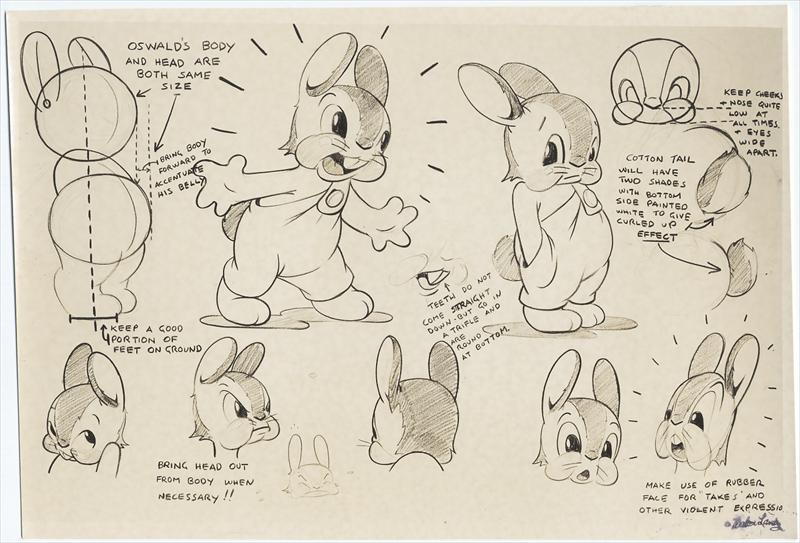
Of course, not all cartoon series released at the time outright copied Disney. However, every animation studio did begin to train their staff to animate more realistically and abandon rubber hose principles. An excellent example of this would be the artistic evolution that took place in Porky Pig's Looney Tunes shorts. Early on, his appearances were marked with less articulated character movements. Porky was initially a very fat young child, not the slimmer adult pig that he later became known as. His redesign increased the character's appeal and believability. Because Porky debuted in 1935, his cartoons rapidly dropped the physics associated with rubber hose, but still utilized exaggerated movements for humorous effects. Another example of a character's evolution towards 'realism' would be the Walter Lantz version of Oswald the Lucky Rabbit. Lantz first redesigned Oswald to be cuter, have more detailed attire, and a personality more in line with that of Mickey Mouse. By the 1940s, the rabbit became completely unlike his former self. He was aged down considerably, lost his black and white color scheme associated with the outdated rubber hose style, and drawn with consideration to realistic weight and proportions.
Walter Lantz's Oswald from the mid-1930s.
A more rabbit-like Oswald from the early 1940s.
Resistance to the Movement & The Screwballs Emerge
Popeye refuses to be like one of those 'bland Mickey cartoons' !
Not every animation studio was quick to abandon the wackiness of rubber hose, in favor of the 'cutesy,' detailed style embraced by Disney. Ub Iwerks did adopt color for his Comicolor Cartoons and pioneer the usage of the multiplane camera (which Disney later adopted). However, the characters in his shorts retained their exaggerated yet simplistic style, and the cartoons themselves were less sentimental and idealistic than Disney's Silly Symphonies were. The Fleisher Brothers held out longer than Iwerks did. Even though they abandoned Betty Boop after the implantation of the Hayes Box Office Code, the company kept making Popeye shorts which continued to perfect its own brand of rubber hose. Likewise, Fleisher's Superman series (1941-1942), while certainly different from Popeye, approached animation with a more graphical style than Disney, focusing more on fast paced action and drama. On the other hand, Looney Tunes began to increasingly refuse to make Disney clones. Instead, they opted for cartoons focusing on slapstick, parodying the cute animal character archetype common at the time. Daffy Duck (1937), Bugs Bunny (1940), and Bob Clampett's early incarnation of Tweety Bird (1942) all followed this trend.
"I'm wooking for wabbits."
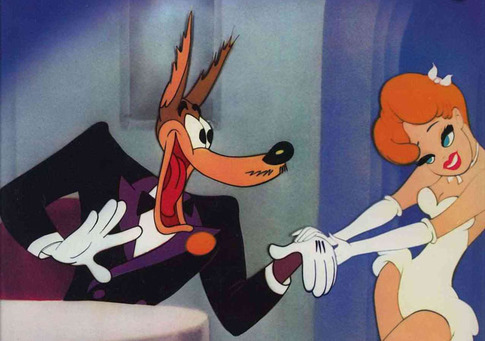
Other companies soon did the same due to WB's success with zany and smart aleck funny animals. After leaving for MGM, Tex Avery gave us Screwy Squirrel (1944), a short lived, literally 'nuts' character who frequently messed with his antagonists' (and the audiences') minds when he broke the fourth wall. Avery also made many one shot cartoons, most notably "Blitz Wolf" (1942), which was a parody of Disney's "Three Little Pigs" and the war against Nazi Germany, and "Red Hot Riding Hood" (1943), which similarly parodied fairytale cartoons popular at the time by updating one for modern audiences. Avery's only consistent recurring character was Droopy Dog (1943), whom Avery loved to use to contrast deadpan humor with other worldly gags. Also at MGM, William Hannah and Joe Barbara created their comedic duo, Tom and Jerry, who first appeared in the 1940 short, "Puss Gets the Boot." Walter Lantz likewise replaced his cute star, Andy Panda, with the zany Woody Pecker, who debuted in "Knock Knock" (1940). Columbia also jumped on the bandwagon when they hired a Warner Brothers employ, Frank Tashlin, to create The Fox and the Crow in 1941. Even Terrytoons, the "Woolworth's of animation," managed to create a few icons such as Mighty Mouse (who started out as a funny animal parody of Superman), and Heckle and Jeckle, two wise cracking magpies.
Tex Avery was the opposite of Disney: wacky, over the top, and sometimes sensual.
What Happened to the Feature Film Outside of Disney?
Why was this film the last major American animated film to be released outside of Disney for many years?
Back in the late 1930s, the only animation studio rivaling the power of Disney was Fleischer Studios. Once Disney met great success with the release of Snow White, Fleischer decided that it had enough resources and the capabilities to do the same. Fleischer first released three Technicolor Popeye Specials between 1936 to 1939, each running around 15 to 20 minutes. The specials had elaborate animation and gorgeous backgrounds that where at the level of what Disney produced at the same time. The experience gained allowed Fleischer to produce its first true animated feature, Gulliver's Travels (1939). Gulliver proved to be financially successful even though it relied very heavily on the use of the rotoscope in order to animate its lead. Encouraged by their success and nomination for two Academy Awards, the Fleischer Brothers put out a second feature in 1941. Mr. Bug Goes to Town is now generally recognized as being the stronger film. It had the artistic merit equal to any of Disney's features, relied far less on the rotoscope, and had an original storyline to boot. Sadly, Mr. Bug proved to be the death knell of the studio despite all of it improvements over Gulliver.It was released two days before the attack on Pearl Harbor. This led to the film being a financial disaster and the rest of its market was cut off overseas. Fleischer Studios could not deal with the debt and thus was shut down. It was bought out by Paramount and then replaced with the lower budget Famous Studios in 1942.
Before the tragedy of Fleischer Studios, several other animation companies considered making feature films. However, they became too scared after what happened to Fleischer, many had to deal with impending production costs, and their was that little issue called WWII. (The later resulted in many propaganda cartoons being made up until 1945.) Thus, competing studios adapted by making more anarchic/humor based shorts than Disney. To say that American cartoons during the 1940s-50s were nonexistent in feature film outside of Disney is not entirely correct though. Popular characters from short subjects did make the occasional cameo in live-action film (in a similar manner to Disney's Song of the South [1946]). Jerry made a memorable appearance when he danced with Gene Kelly in Anchors Awiegh (1945), and would later appear alongside Tom in Dangerous When Wet (1953). Bugs Bunny similarly popped up in a dream sequence in Two Guys from Texas (1948) and in the following year in My Dream is Yoursalongside Tweety Bird. Woody Woodpecker appeared in cartoon within Destination Moon (1950) due to producer George Pal being a friend of Walter Lantz.
Most non-Disney cartoons were reduced to cameos in feature film.
The only exception to this rule during the early 1950s was the stop-motion feature Hansel and Gretel: An Opera Fantasy (1954) which remains little known today, and sort of a cult oddity. Non-Disney American animated movies did not really start to appear again until 1959 (with the release of the Mister Magoo film, 1001 Arabian Nights)and did not really become common until the 1980s-90s (thanks to Don Bluth and the Animation Renaissance). Foreign features were slightly more common. China garnered much attention with Princess Iron Fan (1941), which while technically simplistic compared to American features of the time, greatly influenced future anime directors. Several European features were made as well, such as: Tintin's The Crab with the Golden Claws (Belgium, 1947), The King and the Mockingbird (France, 1952), Animal Farm (Britain, 1954), and The Snow Queen (Russia, 1957). It is also worth noting that Japan released its first significant animated production, Hakujaden, during this period in 1958, hinting at the country's future in the industry.
Overseas, a few quality animated films were made during the 1940s-50s.