Showing posts with label Toei Doga. Show all posts

Tuesday, April 22, 2014

Animated Adaptations of One Thousand and One Nights


All of us are familiar with Disney's Aladdin, but there are a surprising number of other cartoons based on similar premises. 

Background on the Tales

One Thousand and One Arabian Nights is one of the world's most famous collections of fairytales and folktales. It is also one of the oldest literary works. Although the story was originally published in Arabic during the Islamic Golden Age, many of the stories are far older and originate from not only Arabian countries but also Egyptian, Indian and Mesopotamian cultures. The stories first became popular in the Western world after their publication into French in the early 1700s by Antoine Galland. English translations soon followed, becoming increasingly common during the 1800s. Translations have continued to be made and revised up into recent years, as scholars endlessly debate about the accuracy of their sources and interpretations. (Earlier translations made during the Victorian era tended to cut out certain stories or aspects due to their depiction of violence and sex. Not all of these stories were originally intended for children. Pretty much the same thing could be said about Grimm's Fairytales.)


An illustration for Aladdin by Errol le Cain. 

For those unfamiliar with One Thousand and One Nights's basic premise, it is a frame story. Everyday the king Shahryar takes a new bride only to behead her by the next day, and then takes another. (Shahryar holds a grudge after finding out his first wife was unfaithful to him.) Eventually the vizier can no longer find any more virgin brides for the king. The vizier's daughter, Scheherazade, offers herself to be the next bride, and the vizier reluctantly agrees. Later that night after the marriage, Scheherazade begins to tell Shahryar a fantastical story. The story does not end and segues into another tale. The king becomes curious about how the tale concludes, so he postpones his bride's execution. This continues to be repeat until one thousand and one nights have passed and Scheherazade has run out of stories to tell. However, Shahryar has fallen in love with Scheherazade over the course of almost three years. So Scheherazade's life is spared and she becomes queen.


An illustration of Scheherazade and Shahryar by Edmund Dulac.

Most of the stories that Scheherazade tells are highly fantastical, involving various heroes journeying to far off lands in search of love or warriors fighting against fearsome monsters. Arguably, the most famous of these stories are Sinbad the Sailor, Aladdin and Ali Baba and the Forty Thieves. Adaptations based upon these tales range from classical pieces to role playing games. (So many works have been influenced by these tales that they even have their own Wikipedia page!) Naturally, One Thousand and One Nights has been adapted numerous times into film as well, perhaps most famously by The Thief of Baghdad (both the 1924 and the 1940 versions) and the 7th Voyage of Sinbad (1958). The number of animated films adapted from One Thousand and One Nights is quite high as well. The stories provide a perfect vehicle for the medium given how imaginative and other worldly they are.


A brief synopsis and review for The Thief of Baghdad (1940).

Saturday, December 21, 2013

What Were LaserDisc Games?


The short lived craze that helped reignite interest in video games and animation.

For those who didn't grow up during the 1980s or early '90s the word 'LaserDisc' may not exactly be familiar. Think of LaserDiscs as the record size prototype of the DVD. LaserDiscs were first manufactured in 1978, arriving shortly after the VHS beat out Betamax. Unlike the DVD or the Betamax, LaserDiscs utilized disc based technology, resulting in higher quality image and audio quality. LaserDiscs were also the first format to include extra discs filled with extra features. Despite these advantages of the LaserDisc, it wan't until the DVD arrived that optical discs became the preferred video format. LaserDiscs were considerably more expensive than VHS tapes in most regions, very large/awkward to hold, could not record shows on TV, and could not store as much length as the VHS. Thus LaserDiscs were not popular with most of the American public, save for movie buffs or the dedicated otaku.


Laserdiscs: the record sized forerunner of the DVD.

However, LaserDiscs did manage to make a significant (if short-lived) impact on the animation and video game industries. While the idea of the interactive movie was not new at the time (The short film Kinoautomat [1967] is largely considered to be the first.), LaserDiscs made the use of interactive movies more widespread due to their ability to skip back and forth between segments of film and nonlinear play devices. For those unfamiliar with them, interactive movies can be best be described as the video game equivalent of  'Choose Your Own Adventure' books, where the player's actions dictate the result of the film depending on which choices they make. Many LaserDisc games required 'quick time events' where the player has to press the correct sequence of buttons within a short given amount of time, or else they will die. This happens very frequently in LD games, because in order to progress, you must memorize the button sequence. (Thus many quarters are quickly lost if you play them in arcades.)

Enter the Dragon's Lair

Although the first LaserDisc game, Astron Belt (Sega, 1983), was actually a rail shooter that used some footage from Star Trek 2: Wrath of Khan, the first widely successful game was Dragon's Lair.  Released later the same year by ex-Disney animator Don Bluth, Dragon's Lair proved to be so popular that several machines were reportedly broken by children playing on them too frequently. Dragon's Lair is widely credited for saving the sagging arcade industry and renewing public interest in video games after the fall of Atari. It also gave Bluth the much needed money to fund his additional feature films and thus encouraged him and others animators to make material beyond cheap Saturday morning cartoons.

The reason for the game's appeal was simple. Unlike other popular games of the time which utilized simple, pixelated sprites, Dragon's Lair featured high quality hand-drawn animation, which gave the game a greater sense of 'realism'. (Well, realistic enough for a fantasy story about a dim-witted and cowardly knight ['Dirk the Daring'] determined to save a scantly clad princess from a fearsome dragon.) Dragon's Lair was even successful enough to have a sequel released in 1991, which is fondly (or not so fondly remembered) for its rather bizarre time-traveling plot. Dragon's Lair also received several ports to other systems (including the infamous NES version) and had a short-lived cartoon series with noticeably bad animation provided by Ruby-Spears.


Gameplay of Dragon's Lair making it look extremely easy.


In reality, you die a lot. Say goodbye to your quarters!

In 1984, Don Bluth released Space Ace, which is essentially Dragon's Lair in Space. The game had a higher budget with smoother animation, more sound effects better voice acting, and of course, a good dose of strangeness. Thayer's Quest also hit arcades the same year. Although the game was developed by RDI Video Systems (the studio that released Dragon's Lair and Space Ace), Thayer's Quest was made without any involvement from Bluth and has rather shoddy production values in comparison to Bluth's work. Thayer's Quest was initially created for the doomed Halcyon console (which had many advanced capabilities including voice recognition). It ultimately failed due to its extremely steep price of $2,500. In fact, the Halcyon is often cited as the most expensive video game system ever created!


Poster for Space Ace.

Cliff Hanger or Lupin III?

Not all companies could afford to hire American animators like Don Bluth, several of them opted to use footage from anime unreleased in the US at the time and cut it to fit into the storyline they desired. The most famous of these games is Cliff Hanger (1983) which made a cameo appearance in the movie The Goonies. Cliff Hanger was created using footage from two Lupin III games, primarily from The Castle of Cagliostro. As with many anime games released overseas, Cliffhanger had hilarious bad dubbing done directly over the original Japanese and many of the characters in the films either had their names changed or were cut out completely.

Bega's Battle (Sega, 1983) was a rail shooter with footage taken from the anime Harmagedon. Like many popular games of the time, it was featured on Starcade. It had a notoriously violent opening sequence, where a man's face is shown mutating and melting off. (And, yes, this game was marketed towards children.) The anime itself is pretty awful and forgettable despite being directed by Rintaro and produced by Madhouse. Curiously enough, two other of Rintaro's movies,  Galaxy Express 999 and Adieu Galaxy Express 999, were adapted into a 1987 LaserDisc game called Freedom Fighter. Freedom Fighter was the only game before developer Millennium Games shut down. It is thus very rare and highly sought out by collectors.


Cliff Hanger! The game that keeps you on your toes!

Genki Girls & Ninjas: Japanese LaserDisc Games

Several game developers in Japan also made LD games. Super Don Quix-ote (Universal, 1984) which is only notable for being very loosely inspired by Don Quixote and for having low budget animation on par of Thayer.Badlands (Konami, 1984) was a far more interesting game. It plays out as a Western style shooter starring Buck, a cowboy on a quest to avenge the deaths of his wife and children who were murdered by a band of outlaws. Despite, its solemn sounding setup, Badlands is actually quite humorous and silly at times due to its particularly bizarre and nonsensical death animations and random mix of American and Japanese cultural references. On a similar note, Sega also released a vengeance game in 1985. Road Blaster is a racing/shooter game where you play a man tracking down a gang of bikers who killed his wife. Unlike Badlands, the game maintains a fairly serious tone throughout. 

Outside of Don Bluth and Cliff Hanger, perhaps the best remembered LaserDisc games were made by Taito. In 1984, the company released Ninja Hayate, a game suspiciously similar to Dragon's Lair. It is about a Dirk-like ninja who attempts to rescue a princess from a feudal Japanese castle. (Ninja Hayate also bears more than a passing resemblance to another Taito game, The Legend of Kage.) Time Gal (1985) is commonly bundled with the above and is the more famous of the two. The game is set in the year 3001. You play as a skimpily dressed girl named Reika who must travel between different time periods in search of the criminal Luda in order to prevent him from altering the past. Time Gal was one of Japan's more popular LaserDisc titles, receiving numerous ports to different systems over the years. This is no doubt due to the main character being a typical excitable, ditzy 'cute' anime girl (who looks a lot like Lum from Urusei Yatsura). She laughs, spews random English and makes various pop cultural references while being chased. Half of her 'death' animations just involve her being shamed in some way or nearly losing an article of clothing. (This is actually quite creepy once you realize that several of these death sequences cut to a clip of Luda laughing.)


I'm not sure if these death sequences are annoying or hilarious. 

The Decline & Legacy of LaserDisc Games

By the late 1980s, the number of notable LaserDisc games being made began to decline rapidly as the popularity of the format waned. This is because once someone figures out the pattern of buttons needed to be pressed and sequences to choose in these games, the games have practically no replay value beyond showing off your skills to your friends. LD games thus get very repetitive over time and are often quite similar to one another in gameplay and in structure. The only major producer of LD games in the late 1980s and the early '90s was American Laser Games, which made a total of ten games up until 1994. Unlike most developers, American Laser Games used cheaply shot live-action footage which has little enjoyment beyond its camp value. All of their titles were light rail shooters which had lousy green screen effects. Most of their games were either Westerns, space dramas, or crime narratives. In 1991, Dragon's Lair's co-creator, Rick Dyer, released Time Traveler through Sega. The LD game was the first video game to utilize holographic imagery, however its standard plot about traveling through time in order to rescue to the protagonist's girlfriend may have weakened its appeal. Ultimately, Time Traveler's gimmick could not save LaserDisc games. Within four years, the DVD was introduced and the LaserDisc quickly faded into obscurity.

Although LD games were short-lived, they managed to greatly influence the future of gaming. Dragon's Lair helped re-spark public interest in the medium after the Video Game Crash of 1983. LD games pioneered the notion that games could use branching paths based upon the player's choice, introduced the notion of cutscenes to gaming, and introduced full animation to gaming. While interactive movies remain a niche market, several notable ones have been made in recent years, including Heavy Rain and Beyond: Two Souls. Although these games are far more sophisticated, they owe a lot to their LaserDisc heritage.


What's the point of a low budget game if it's not animated?

Monday, February 11, 2013

The Most Influential Animations You Never Heard Of (Part 2)

Here are the next five animated works that are historically important, but often overlooked by the public. All of entries here are from outside of the United States.

6. Animal Farm (1954): The First 'Adult' Animated Feature


"All animals are created equal, but some are more equal than others."

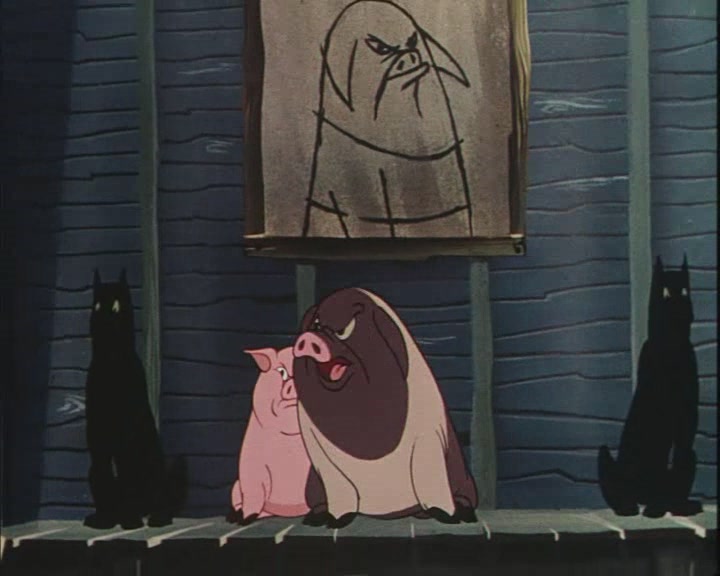
Animal Farm is one of the most famous cautionary tales ever penned. George Orwell's novel was more than just a warning about Russian communism, but also about dictatorship and corruption in general. The film adaptation of Animal Farm was directed by Halas and Batchelor and was the first British animated feature to ever be released. Ironically, many of the animators who worked on Animal Farm formally were employed at Disney. However, the adaptation remained very loyal to the book (save for its slightly more 'optimistic' ending). Although the film is a bit heavy on the narration and the animation is somewhat dated, it is a compiling example of an 'adult cartoon'. It is intellectually mature not just dubbed 'mature' for using harsh language or glorified violence. (Yes, I'm looking at you Adult Swim!) Animal Farm is bleak, but it is an important film. It is not a perfect film, but it is a notable effort.


"Pig Brother is watching you!"

7. The Snow Queen (1957): Another Example of European Animation Influencing Anime


"Do you remember what love is, Kai?"


Russia produced many great animated films and shorts back in the day. One of the most acclaimed film directors during the country's 'fairytale film era' was Lev Atamanov. His most acclaimed movie was The Snow Queen, based off of the Hans Christian Anderson story of the same name. It was hugely important and inspired many generations of Russian animators and remains very popular in its homeland today.

The film's animation is simply drawn, but somehow seems complex at the same time. Each background of the film is lovingly rendered. The visual style of The Snow Queen and other European animated films from around the same time also hugely influenced the look of anime. Toei Doga and Hayao Miyazaki were particularity impressed by the film's aesthetics and storyline, urging them to create unique and ethnically inspired films to stand out from Disney.

The Snow Queen is about a young girl, Gerda, who must go on a perilous journey to save her friend, Kai, who was stolen away by the Snow Queen after he mocked her. One of the great things about this film is that it allows the audience to relate to each character. We obviously feel for Gerda and want her to be successful in her quest for Kai. However, we also come to sympathize the Snow Queen. She is cold and harsh, but also very lonely. Kai is probably the only company she has had in eons. Many other characters, such as the Robber Girl, seem bad at first, but are then shown to be relatable people stuck in difficult situations. It's a shame that this film has never been restored in the US and remains in the public domain, poorly dubbed.


Gerda and Kai, the two protagonists. 

8. Hakujaden (1958): Japan Becomes a Dominant Player


 Japan's first major animated contribution. 

Ever since the late 1980s, Americans have been increasingly aware of (and influenced by) the impact of anime on pop culture. However, many are unaware how far back anime's history goes. (That will be covered sometime in the near future on this site.) The Japanese found it very hard to compete with animation overseas, particularly from the USA and China. It wasn't until after WWII that the animation industry started to become more mainstream. Manga artist Osamu Tezuka and the animation studio, Toei Doga, were among the earliest to popularize home-grown cartoons. Toei Doga made its big break when it released its first film, Hakujaden (The Tale of the White Serpent), in 1958. It was based off of a Chinese folktale of the same name. Hakujaden was also Japan's first ever (non-propoganda) animated film and one of the earliest anime to be in color. 

The movie was a huge undertaking, but paid off well. It was hugely successful in its homeland, despite never garnering much attention in America. (Which might explain why we are stuck with yet another crappy public domain copy!) Hakujaden was Toei Doga's attempt to try and be the 'Disney of the East'. In many ways, it certainly resembles a Disney film more than most modern anime. ('Modern' anime did not begin to emerge until the late 1960s - early 70s.) The film has many musical numbers, cutesy animal sidekicks, and stars two lovestruck protagonists. However, it is also distinctively Japanese. Hakujaden's art style, character designs (by Yasuji Mori), and overall appearance have just as much influenced modern anime as Osamu Tezuka's manga. In fact, legendary anime director Rintaro first began working in the animation on this film (at only 17!) as an in-betweener. A young Hayao Miyazaki also saw the film which inspired him to become an animator.


A really nice promo for the film, showing animators at work!

9. The Thief and the Cobbler (1964 - 1995): How it Saved the Art of Animation


The most significant animated film 'never' made.

Since this film has been mentioned on this site several times before, this entry will be 'brief'. In the early 1960s, animator Richard Williams planned to create the greatest animated film ever. However, he met several financial and backing issues which kept the film in production for years. The Thief and the Cobbler was not released until 1995, as a horribly butchered version after the project was given to another director. (Fortunately, a non-profit restored version known as the Recobbled Cut is now available on Youtube.)

Despite The Thief's long and troubled production, it was very important for preserving the skills of famous animators and passing them on to a new generation. During the 1970s and up until the late 1980s, the art of animation in the West was literally in danger of dying out. This was due to several factors. Walt Disney had died, leaving his studio in chaos and tight on money for several years. The company released relatively few films for the next ten years after his death. It even resorted to reusing / retracing animation from previous films due to inflating costs. (For those finding this hard to believe, check out this Youtube link!)

Also, the 1970s marked the rise of independent and adult animation. It was certainly a good thing that many new styles were being experimented with and more people were becoming involved with the animation industry. However, there was one unintended drawback, not many of these new artists had learned the skills that animators of the Golden Age had been trained in (i.e.: realistic figure drawing, professional art classes), nor did they have accesses to high quality materials.

The dominance of television also encouraged drawing cheaply and as quickly as possible. Over zealous parental watchdogs (the most notorious being Peggy Charren), demanded that childern's television must be censored to discourage 'antisocial behavior.' (Apparently, these people failed to realize that many theatrical cartoons were never intended for children in the first place! Betty Boop or Red Hot Riding Hood anyone?) Thus, the production of mediocre and forgettable cartoons was encouraged and even today animation faces the degrading label of 'kid's entertainment.' (TV Tropes has an excellent article on this issue entitled, 'The Animation Age Ghetto.')

As a result of all these factors, the artistic quality of animated films produced in America during the 1970s and most of the 1980s plummeted to all time low. But several famous artists who had formally worked for Disney or Warner Brothers (including Ken Harris, Grim Natwick, and, Art Babbitt) worked with Williams on The Thief and the Cobbler. They trained an entire new generation of animators. It is quite possible that, if these artists were not kept busy on The Thief, there would have been no Disney Renaissance or rebirth of animation during the late 1980s and into the 1990s. 


CGI? Nope, this film was completely hand-drawn. 

10. The Vampires (1967): The First 'Mature' Manga


A game changer in the field of manga (and anime).

Osamu Tezuka was one of the most famous manga and anime artists who ever lived. He was responsible for popularizing both mediums in the East and in the West. Many of Tezuka's creations (such as Astro Boy, Kimba the White Lion, and Princess Knight) are as familiar to Japanese audiences as Disney and Pixar are to American filmgoers. The vast majority of Tezuka's earlier work was primarily aimed at family audiences. However, Tezuka was never afraid to allow some heavy topics enter his work. He commonly addressed death, gender identity, and the abuse of science and technology.

But manga and anime were still considered to be primarily for children when Tezuka first entered the industry. When his manga was adapted into anime on television, it was commonly watered down to avoid upsetting more conservative viewers and American broadcasters. In the process, some of Tezuka's stories lost part of their meaning when adapted to TV. For instance, when Jungle Emperor Leo (Kimba the White Lion) was first brought to TV several changes were implemented. Kimba was to remain a cub and not grow up (as he is shown to do in the manga). This was to make the series more 'marketable' to young childern. Also, Kimba dies at the end of the manga, sacrificing his own life so that animals and people could continue to strive towards peace. This, of course, was axed because the distributors feared that it would disturb the children too much.

In the late 1960s, things were beginning to change. The advent of the Vietnam War, the Civil Rights Movement, and Counterculture movement, and other social changes began to reflect in the media. Manga and anime were not exempt from this. Artists began to take more risks, speak out, and create darker stories reflecting the change around them. Osamu Tezuka created one of the first manga to be influenced by such change, The Vampires. Which paved way for series such as Lone Wolf and Cub, Black Jack, and the controversial works of Go Nagai.

The Vampires starts out as humorous take on the classic horror genre, but quickly evolves into a more mature work focused on the ugly side of humanity and the abuse of power. The antagonist, Rock MacBeth, desires nothing more than to dominate others. Rock is not below anything. As he tastes more and more power, he becomes intoxicated with it. He murders an entire family to steal their wealth and even kills the protagonist's, Toppei's, potential love interest. At one point, Rock nearly realizes he has gone to far when he kills his childhood friend in a fight, but then blames the world for his problems. He also loses the other only person who cares for him, Ruriko, after his scheme using the vampires backfires.

Rock gained his power by abusing Toppei, a young man who unfortunately changes into a wolf every time he gets angry or is threatened, forcing him to carry out much of Rock's dirty work. Toppei is a vampire, but not of the Hollywood sort. In this manga, vampires are people who change into animals by some sort of trigger. (For instance, Toppei's little brother, Chippei, becomes a wolf whenever he sees anything round.) As a result, of their transformations, the vampires have long been feared by the rest of humanity and historically were hunted down and killed. (This alludes to the wrongs of the witch hunts in Salem and in Medieval times.) The modern vampires in the manga are forced to go into hiding and are commonly segregated from the rest of society (which alludes to racism). Because most of the vampires were persecuted by society, they are eager to aid Rock who promises them glorious revenge. Only Toppei and a few others are able to see through Rock and recognize his true nature.


The original layout of a manga page from The Vampires.

Thursday, January 3, 2013

The Laputa Animation Film Festival: Part I

 The Laputa Animation Film Festival (named after the famous film by animator Hayao Miyazaki) was held during 2003 in Japan. 140 animators worldwide were asked to name their personal favorite 20 animated works (features, shorts, TV series). Based on this information 150 were chosen as the best cartoons from around the world.

This is a great list because it exposes Western audiences to a wide variety of films that they may have never seen or let alone heard of. It is very diverse and not limited to just listing popular anime, Disney movies, or Pixar films. So without further ado, here are the first 25 Best Animated Works:

(Yuri Norstein, RUSSIA /USSR, 1975)

(Yuri Norstein, RUSSIA /USSR, 1979)


(9 Disney directors, USA, 1940)


(Frédéric Back, CANADA, 1987)


 (Paul Grimault, FRANCE, 1953)


(Hayao Miyazaki, JAPAN, 1978, 26 eps.)


( Hayao Miyazaki, JAPAN, 1988)


(David Hand/Disney, USA, 1937)


(George Dunning, UK, 1968)


(Yugo Serikawa JAPAN, 1963)


 (Isao Takahata, JAPAN, 1968)


12. Crac! 
(Frédéric Back, CANADA, 1981)

(Dave Fleischer, USA, 1941)

(Nick Park, UK, 1993)


(Kenzo Masaoka, JAPAN, 1943)

(Hayao Miyazaki, JAPAN, 1984)


(Lev Atamanov, RUSSIA/USSR, 1957)


(Norman McLaren,CANADA, 1955)


(Hayao Miyazaki, JAPAN, 1986)


(Hayao Miyazaki, JAPAN, 1979)


(Jan Svankmajer, CZECHOSLAVAKIA/USSR, 1982)


(Jiri Trnka, CZECHOSLOVAKIA/USSR, 1965)


(Alexander Alexeieff & Claire Parker, CZECHOSLOVAKIA/USSR, 1959)


                                                     24. Night on Bald Mountain 
(Alexander Aléxeieff /Claire Parker, FRANCE, 1933)


25. Dojoji Temple  
(Kihachiro Kawamoto, JAPAN, 1976)