Showing posts with label France. Show all posts

Wednesday, September 9, 2015

The Song of the Sea (Review)

Director: Tomm Moore

Company(s): 
Cartoon Saloon, Digital Graphics, Magellan Films, Melusine Productions, Noerlum Studios

Year: 2014

Country(s): Ireland, France, Belgium, Denmark, Luxembourg


The next Miyazaki is in the making.

Cartoon Saloon is quickly establishing itself as a new animation powerhouse. The studio was founded in 1999, but did not really come into its own until the late 2000s following the release of several short films and its first feature, The Secret of Kells (2009). With the release of their newest movie, two TV series and upcoming feature in the works, Cartoon Saloon is setting an example for other small studios. Ethnically inspired, homegrown cartoons can find audiences, as they offer something different than typical Hollywood fare.

As for The Song of the Sea itself, it is a bit of a departure from Cartoon Saloon's previous film. While also heavily inspired by Irish mythology and traditions, it is set in modern times, specifically 1987. (The Secret of Kells is set around 800 AD.) Both of the film's art styles are also somewhat different as well. The Secret of Kells is dominated by interlacing spirals, geometric patterns, and thick outlines. On the other hand, The Song of the Sea veers more towards a rounded look, with smooth edges and sepia colors. However, the two movies share a similar theme: They stress the importance of family, and maintaining a sense of hope during difficult times. 


Tension bubbles just under the surface within the family.

The Song of the Sea focuses on ten year old Ben, his six year old sister, Saoirse, and his father, Conor. Conor is left heartbroken by the departure of his wife, Bronagh, who disappeared into the sea after giving birth to Saoirse several years before. Ben has grown to resent his younger sibling, due to all of the attention she receives from Conor, and to the fact that he associates her with his mother's disappearance. Saoirse is a very bright and curious child, but is also mute. Saoirse is the spitting image of Bronagh. In fact, she is later revealed to be a silkie (a person who can transform into a seal) like her mother. 

After Saoirse is found washed up on the shore on her birthday night, Grannie decides that Saoirse and Ben would be better off living with her than their alcoholic father. She takes the two siblings to live with her in Dublin. However, Ben plans to run back home on Halloween night. At the same time, Ben  discovers that the fairytale stories he was told by his mother appear to be real, when he and his sister encounter several figures form Irish mythology on their journey back home.


Boredom was also a good motivator to leave Grannie.

The characters in The Song of the Sea are complex and all grow through the trials they experience in their lives. At the start of the film, Ben is far more comfortable retreating into the world of comic books and reading his mom's stories than living in the present. He lavishes attention on his sheepdog, Cu, but rarely shows much affection towards Saoirse. It is not until Saorise falls ill that Ben realizes how much he has neglected her, and he decides to take matters into his own hands. 

Ben encounters many fairytale creatures on his quest to cure his ill sister (and, ultimately, save the rest of her kind). Some of them offer Ben advice, such as the forgetful but knowledgeable Great Seanchai, while others, such as the witch Macha, end up needing Ben's help instead. Macha is a particularly interesting character. Initially, she is introduced as the film's antagonist. She steals people's feelings and turns them to stone. However, we later learn that Macha does so in an attempt to rid others of bad feelings, she has even turned herself partly to stone in the process. Macha's first victim, in fact, was her son the giant Mac Lir, who was morning over the loss of his lover.


Both Ben and the witch, Macha, learn that locking up your emotions can actually do more harm than good in the long run. 

These mythological figures mirror people in Ben's own life. (And are in fact, portrayed by the same voice actors.) Macha represents Grannie, who attempts to help her family, but ends up accidentally causing tension by moving her grandkids in with her. Mac Lir represents Conner who is paralyzed by the loss of his wife. Finally, the Great Seanchai represents Dan the Ferryman, who acts as Ben's link to the outside world and offers him advice. 

At first glance, the animation used in The Song of the Sea seems rather simple looking. However, this works to the movie's benefit rather than hindering it. The stylized characters fit the mood of the film. They contrast with film's extremely detailed backgrounds, helping establish a relatable, but slightly otherworldly look. Since Ben's quest takes him between both the human and faerie worlds it works rather well. 


Both the final animation and concept art are beautiful.

The Song of the Sea is clearly a labor of love, having spent over five years in production. It tackles subjects not normally touched upon in mainstream family films, but does so in a way that is perfectly acceptable for children and that is easy to understand. The Secret of Kells already proved that Tomm Moore is a talented director, and this film further proves it. It is easily one of the best animated films to recently come out, and it was wrongfully robbed of its Oscar. Hopefully, The Song of the Sea will eventually get the attention it deserves.


Learning to accept life's troubles and moving on is the key to happiness.

Rating: 5/5

Tuesday, September 16, 2014

The Tale of the Fox (Le Roman de Renard) Review

Director: Ladislas & Irene Starevich

Company: UFA

Year: 1937

Country: France, Germany


Obscure but historically important, this movie is like no other.

Although Disney's Snow White is often misidentified as the first full length animated film, there were actually eight other movies released before it. The Tale of the Fox was the sixth animated feature to be released. It was also the second to utilize stop-motion after the 1935 Soviet film, The New Gulliver. (Le Roman de Renard's animation was actually completed by 1930.) and the third to utilize sound. (However, the film did obtain a soundtrack until several years later due to funding issues.) The film was originally released in German (as funding was given by the National Socialist Regime) and later in French in 1941, which is the version currently available for home viewing. The movie is rather obscure outside of France today, likely because distribution was cut off due to WWII. This is truly a shame as director Ladislas Starevich was a true pioneer in his field, and Le Roman de Renard was his only full length feature.

Le Roman de Renard is based upon the medieval beast fable, Reynard the Fox. The story has been adapted into animated form several times. It was written as a political satire of aristocratic society which made the Reynard character popular among European peasants. Unlike many other 'modern' adaptations of the tale, Le Roman de Reynard remains very loyal to the original story and is aimed more at older audiences then at young children.


The original theatrical poster for the film.

The film begins with a narrator monkey operating a film camera. He tells the audience that he has a tale to share with them that is "the oldest and most beautiful story known to us animals." He opens a book introducing some of the film's main characters: the vain Monsieur Raven, Sir Cock and his wife Lady Hen, the fearful Hare, the king's guard dogs, Isengrim the Wolf, and finally Reynard himself. Reynard is very smart. Within the first five minutes of the film, he manages to steal a piece of cheese from Raven by flattering him. Isengrim is introduced as Reynard's rival. The wolf is larger and stronger than the fox, but not nearly as bright. One night, Isengrim plans to steal some fish off of Reynard for his family's dinner. Reynard then tricks the wolf into 'fishing' by claiming that by sticking his tail into a hole in the ice he can catch a large amount of fish to eat. In the end, Isengrim returns home with no dinner (and no tail) only to discover Reynard has stolen his food instead! (It should be noted that both of these episodes are also featured in Aesop's Fables.)

Reynard's pranks on Raven, Isengrim and several other animals eventually result in several complaints to the King Lion and his wife. Reynard's cousin, Badger, defends him in court, stating that the fox is not guilty. He weaves tales of Reynard's 'good deeds' and frames Isengrim and the other animals as being lazy, dishonest, cowardly or greedy (which aside from the 'good deeds' part is, ironically, true to some extent). The King is unable to prove Reynard's crimes, so he decrees that no animal can no longer eat one another so that 'love can reign the land.'

The movie is unusual because its protagonist is not the kind of ideal hero that we are commonly accustomed to seeing in animated films. As with many of the other characters in this film, Reynard is a self-centered survivalist. Not all of Reynard's actions are entirely harmless. The fox is far from being enthusiastic about the King's new law. (In fact, he refuses to go vegetarian despite the risk of being hung because he finds the taste of flowers disgusting.) Badger is unable to defend his cousin when Reynard kills and eats Lady Hen. The rooster calls for revenge and the king sends several of his members of court to capture Reynard and his family. In the end, however, the cunning fox manages to outwit everyone including the King himself. Because the King's army is unable to successfully siege Reynard's home, the fox is selected as the king's new minister. Such is politics.


While it's easy to admire Reynard's quick wits, he's also somewhat of a selfish jerk.

Narrative structure aside, The Tale of the Fox is probably most noted for being a technical marvel. Despite that the movie is almost eighty years old the stop-motion holds up remarkably well, even rivaling what is put out by today's studios. This is especially notable because Le Roman de Renard premiered only three years after King Kong, which special effects look very dated by comparison. The film features many cutting techniques and a use of motion blur largely unseen at the time. Below, is a clip from the film involving the Queen being wooed by Tybalt, the minstrel cat. (Their doomed relationship is an interesting subplot present throughout most of the movie.) It demonstrates this movie's mastery of its medium.


The iconic scene where the peasant cat woes the queen.

This movie is one of the most unique and unusual films I have ever seen. It is an absolute must watch for not only lovers of animation, but for any film enthusiast period. Reynard and the other animals in this movie are not always the most admirable characters, but they are relatable due to their remarkably human flaws and impulses. Although this film is old and is different from much of what is produced today, it is very memorable for exactly that reason. If you are feeling adventurous, Le Roman de Reynard is more than worth your time. (The entire film is currently available on Youtube with English subtitles and can be watched here.)


Ladilas and his wife, Irene, posing with large scale versions of the puppets used in this film.

Rating: 4.5

Wednesday, March 26, 2014

11 Amazing Short Student Films from Gobelins Animation School

The French have always been heavily involved throughout the history of animation and hosts a variety of prestigious universities, the best known being Gobelins School of Image. Gobelins is a college located in the Latin Quartier dedicated to the visual arts. Since Gobelins began offering its animation program in 1975, several of its students have gone on to work for several companies not only within in France, but also at large studios including Disney, Dreamworks, Pixar, and Warner Brothers. The rising star in animated film companies, Illumination Entertainment (Despicable Me, The Lorax), was founded by a Gobelins alumni Pierre Coffin. Each year, the Gobelins Youtube page posts their students' graduate films, most of which are nothing short of remarkable. Below I have listed eleven of my favorites in chronological order (with descriptions from the Gobelins website). Why eleven? …Making lists is hard.* 

1.) After the Rain - 2008


"A child fishing in a puddle using bananas as bait catches a bigger fish than he can handle and flees with the giant fish in pursuit."

2.) For Sock's Sake - 2008


"A sock escapes from the clothes line to go clubbing."

3.) Trois Petits Points - 2010


"A seamstress is waiting for her husband to come back from the war."

4.) Le Royaume - 2010


"Just arrived in a wood, a king wants a beaver to build him a castle."

5.) A Travers la Brume - 2011


"Two brothers are hunting a legendary creature. As they hunt, the fog separates them…"

6.)  Fur - 2011


"Banned from his town because of his animality, a wolf man decides to make this segregation come to an end."

7. ) Who's Afraid of Mr. Greedy - 2011


"A man comes to get back his identity, stolen by an ogre while he was a child."

8.) In Between - 2012


"A young woman is being followed by a crocodile who represents her shyness. As he makes her life a living hell, she tries by every means to get rid of him."

9.) Trouble on the Green - 2012


"In a little french town, a minigolf tournament is organized each year. But this year, the news have announced the end of the world."

10.) One Day - 2012


"One man always on the move will have an encounter that puts into question everything he knows."

11.) Eclipse  - 2012


"On a distant planet, two sientists analyzing the field for its magnetic properties are facing an extraordinary phenomena linked to the lunar eclipse."

* For those who enjoyed this list, I recommend checking out the 2013 graduate shorts,  Un Conte (not for the faint of heart) and Annie (which is reminiscent of Scott Pilgrim and Adventure Time). The Gobelins students also create television spots for the Annecy International Animation Film Festival. Notable spots include Monstera Deliciosa (2009) and Beyond the Sea (2012).

Friday, February 7, 2014

The Oscar Nominated Shorts of 2014 (Who Will Probably Win & Who Should Win)


The Oscars are fast approaching with a live screening set for March 2nd. While the Oscars are and have always been biased towards certain films (specifically English speaking ones usually produced by major Hollywood studios or well known directors), they have become increasingly popular and prestigious. The movies nominated for best picture always get lots of fanfare, but films in other categories are sometimes overlooked.

The short film categories often suffer from this. This is shame because they are a great way to showcase talents from across the globe. Because they cost significantly less to produce they can vary greatly in their subject matter and style. While some of them are made by larger studios, many of them are not and are very personal films made by small independent creators/companies passionate about the medium.


The Oscar nominated animated shorts from last year.

For those of you who have yet to see them, the Oscar nominated animated shorts this year, are overall, a pretty solid bunch. The nominees include a Disney short, three entries from Europe, an anime, and an independently produced short. If you happen to attend the screening of the nominees at your local theater, you will probably notice that the program also includes three honorable mentions which were not nominated for the Oscars. Fortunately, they are also fairly enjoyable as well. (Unfortunately, the animated shorts are 'hosted' between each segment by two obnoxiously unfunny CGI animals. But, hey, at least the awards aren't being hosted by Seth MacFarlane again this year.) So without a further ado, here are some brief reviews (and winner predictions) for the nominees and honorable mentions for the Best Animated Short of 2014.

The Nominees

Get a Horse!


Director: Lauren Macmullan
Company: Walt Disney Animation Studios
Country: USA

Get a Horse is a throwback to Disney's original rubber-hose Mickey Mouse shorts from the early 1930s with a twist. When Peg Leg Pete attempts to run a hay wagon off the road, Mickey and Horace are forced out of the movie screen and into the theater, becoming CGI colored versions of themselves. Horace and Mickey then battle Pete, who has kidnapped Minnie, by finding ways to interfere with movie playing on screen. While the premise is a bit gimmicky and not entirely original, (Tex Avery loved inserting self aware sight gags into his cartoons, and Get a Horse bears some resemblance to Osamu Tezuka's 1985 short, Broken Down Film) the film has been made with so much love and passion it is hard not to smile at the character's antics.

Get a Horse is not necessarily the best nominee, but it has already become an audience favorite, having won the Annie Award for Best Animated Short Subject and being nominated for Best Animated Film at the San Diego Film Critics Society. More than likely it will probably win the Academy Award. Get a Horse also features original voice recordings from the 1930s, marks the first appearance of Oswald the Lucky Rabbit in a Disney cartoon in over 84 years, and is the first Disney production to be directed solely by a female animator.

Rating: 3.5

Mr. Hublot


Directors: Laurent Witz & Alexandre Espigares
Company: ZEILT Productions, WATT Frame
Country: France

Mr. Hublot moves at a far more leisurely pace than Get a Horse and has no dialogue. However, this largely aids the film rather than hindering it. The short follows a little mechanical man who lives in a Victorian era steampunk-like society. But Mr. Hublot largely chooses to ignore the beautifully rendered CGI/ stop-motion animated landscapes around him. Instead, he focuses intently on his work, preferring the company of his typewriter indoors rather than socializing with others. One day, his work is disrupted after he discovers a small robotic puppy abandoned outside his apartment. Mr. Hublot takes pity on the creature and adopts it. Eventually the puppy grows into a huge dog, and Mr. Hublot is faced with a difficult decision: Should he keep his pet / only friend and allow it to disrupt his work? Or should he get rid off it?

Mr. Hublot is a charming short. Although the story is a bit familiar, the short's animation is very distinctive and Mr. Hublot's apparent OCD is very relatable in our day and age. While not as likely to win the AA as Get a Horse, this film has a bit more substance to it. I would love to see what the short's creators do next.

Rating: 4/5

Feral 


Director: Daniel Sousa
Company: SousaAnimation
Country: USA

Feral greatly contrasts from the other contestants mentioned so far. It is not cute, funny, or heartfelt, but it is a rather mature, gloomy piece. The short tackles a difficult, yet intriguing subject with no clear answers: How would a feral child react if suddenly he or she were suddenly placed back into society? The huntsman who discovers the lost boy in the film certainly thinks that he is helping the child by reintroducing him to his 'proper place' in society. But the audience is left unsure, especially after they see the boy alienated by his strange new environment. The boy tries to adjust by using the same methods that kept him safe in the woods, but is teased by his peers and misunderstood by others. Feral ends openly with the boy running back towards the forest.

The short is quite ambitious and manages to tell its story with little to no dialogue, but, unfortunately, it can be difficult to understand at times due to its level of abstraction. Feral is indeed beautiful to look at, but feels a bit unevenly paced and may leave its audience cold. Still, one has to admire the efforts of Daniel Sousa's creation as he created almost entirely by himself.

Rating: 3/5

Possessions


Director: Shuhei Morita
Company: Sunrise
Country: Japan

Possessions is perhaps the most unique of all of the nominees and bears a couple of distinctions. It is the first anime film to be nominated that has not been directed by Hayao Miyazaki and its animation is blend of both cel shaded characters and traditional background art. The film's director, Shuhei Morita, is perhaps best known for his half-an-hour ghost story film, Kakurenbo ['Hide and Seek']. (It should also be noted that Possessions was originally part of an anime anthology film, Short Peace, which contained three other shorts including the award winning Combustible.)

In Possessions, a traveler comes across a shrine when he tries to find shelter from pouring rain. He decides to spend the night there, but notices that the shrine is full of neglected items. According to Japanese legend, abandoned items will come to life after one hundred years have passed. The umbrellas, kimonos, and other objects attempt to scare off their unwanted guest. However, the man decides to mend all of the tarnished objects instead and is rewarded for his efforts. Possessions may be more unusual then some of the other candidates, but there is still a small chance it could win. After all, Miyazaki's Spirited Away won Best Animated feature back in 2002 (making it the only anime film to do so so far).

Rating: 4/5

Room on the Broom


Directors: Jan Lachauer & Max Lang
Company: Magic Light Pictures
Country: UK

Easily the cutest entry on the list, Room on the Broom is based on a picture book by Julia Donaldson. The short also sports a well known cast, featuring the voices of Gillian Anderson, Rob Brydon, and Martin Clunes among others. Like Mr. Hublot, Room on the Broom blends several animation mediums (specifically models for the sets, CGI for the characters, and traditional animation for fire and water effects). This gives the film its own unique look, which is refreshing in this age where everybody seems to try and copy Pixar's style.

The short itself, is of course, aimed primarily at children, but is actually the longest nominee running at about half an hour. It manages to keep audiences of all ages alike amused with its gentle humor and rhyme filled narration. Room on the Broom is about a kindly witch who flies around with her grumpy cat in tow. The witch keeps dropping things, but the objects are always found by a forest animal. The witch always invites them to ride on the broom with her, despite her cat's protests. However, the broom eventually becomes to heavy to float and the witch runs into trouble with a hungry dragon. While nothing complex is offered in this short, it is quite enjoyable and certainly will please young ones and their families.

Rating: 4/5

The Honorable Mentions

A La Francaise 


Directors: Morrigane Boyer, Julien Hazebroucq, Ren-Hsien Hsu, Emmanuelle Leleu, William Lorton
Company: Supinfocom Arles Animation Film School
Country: France

A la Francaise is sort of a one trick pony. The short is about a bunch of pompous 18th century aristocrats attending a party at Louis XIV's palace…except that they all happen to be chickens. That's about it. Most of the gags actually tend to be pretty funny though and occasionally even a little risqué. The plot becomes increasingly chaotic and disorganized after a hen writing down all of the details about the party loses her papers, which fly throughout the ballroom and start offending all of the guests.

The biggest letdown of this short, however, is its very unsatisfying ending. The audience doesn't even get to see Louis XIV's full reaction to the disasters occurring around him. Still, there is much to be admired about this short on a technical level, given that it is CGI student film that was worked on by only handful of people over the course of three years. It's apparent why A la Francaise wasn't nominated, but it was rightfully given an honorable mention.

Rating: 3/5

The Missing Scarf


Director: Eoin Duffy
Company: Belly Creative Inc.
Country: Ireland

The Missing Scarf is one of those films that takes all of your expectations then completely subverts them in the best possible way. The short begins like a typical children's story. Narrated calmly by George Takei, it tells the tale of Albert, an optimistic squirrel, who has lost his scarf. Albert goes to the woods to search for it, but meets several other animals who have problems of their own (such as an owl who is afraid of the dark and a fox who fears being disliked by others). Albert gives each of them advice about how to deal with their problems, however the short becomes subtly darker as time goes on. So much so that even the bear's troubling existentialist question may not seem as impractical as it sounds.

The Missing Scarf's animation, done in a combination of Adobe Flash and Blender, suits the style of the film well. It is simple and to the point. The cute character designs also greatly contrast with the black humor at The Missing Scarf's ending. Personally, I think this short should have also been nominated, but The Missing Scarf was probably too unorthodox for the Academy's tastes. Their loss.

Rating: 4/5

The Blue Umbrella 


Director: Saschka Unsled
Company: Pixar
Country: USA

Many people where surprised when they discovered that Pixar received no nominations this year, not just for their main feature, Monsters University, but also for for their short, The Blue Umbrella. In the case of The Blue Umbrella, however, it is pretty apparent to see why it wasn't nominated. There is nothing wrong with the film, in fact it contains some beautiful CGI effects and utilizes some really creative animation on various inanimate street objects. However, The Blue Umbrella fails to offer its audience anything that they haven't already seen before.

The story is cute (involving a male blue umbrella who gets separated from his love interest, a red female umbrella), but it bares an uncanny resemblance to the 1954 Disney short, Jonny Fedora and Alice Blue Bonnet, and is rather predictable. The animation on the umbrellas is also somewhat disappointing. The drawn on cartoon faces simply don't blend very well with the short's otherwise photorealistic style.

Rating: 3/5

Sunday, July 21, 2013

Before CGI: Stop-Motion Special Effects in Film


Dinosaurs, monsters, and robots, Oh my! 

Today, it is easy to take for granted all of the spectacular sights and fantastical creatures that appear on screen, largely due to the increasing efficiency and availability of computer animation. But prior to the 1990s, such special effects had to be done entirely by hand. There are several alternate options to CGI. Puppetry, which first originated in 3000 BC, involves manipulating inanimate objects to make them look alive in real time. Commonly described as 'mechanical puppets', animatronics were developed by Disney during the 1960s. They have brought characters such E.T., Jaws, and the Gremlins to life.

However, most special effects were created primarily through stop-motion. The technique has a long and interesting history, being used in film for over one hundred years. Unlike puppetry and animatronics, stop motion involves physically moving objects frame by frame for each shot. Therefore, it is a very time consuming process. (Fully stop-motion animated films take an average of five years to make!) Anything can be animated using stop motion animation, be it clay, wax, Legos, action figures, dolls, or even dead bugs.

Georges Melies: The Father of Special Effects


Early filmmakers were crazy. Crazy but ingenious. 

Not only did Georges Melies utilize stop-motion in his trick films, he also created illusions by using time-lapse photography, manipulating perspective, hand dying his films to create color, and by making outlandish costumes for his casts. Melies was passionate about bringing the unbelievable to life on the screen. Most of his films involve fantastical elements, be they Jules Vern inspired science fiction or elaborate period pieces. Melies created over 500 short films between 1896 to 1913. One of Melies's earliest works, "The Haunted Castle" (1896) is sometimes cited as the first horror film, although if was created to amuse people rather than to scare them. "The Vanishing Lady" (1896) is also notable. Its use of a hidden trap door made it appear that Melies 'disappeared' a young woman and replaced her with a skeleton. "The Astronomer's Dream" (1898) is perhaps the best known, and most surreal, of Melies's earlier shorts.  

Georges Melies's later work became increasingly more sophisticated. Rather than being a few minutes long and merely filmed magic tricks, they could be up to half an hour long and featured actual plotlines, a cinematic first. "A Trip to the Moon" (1902) is still commonly referenced and homaged today. The short was about a group of scientists who journey across space, land on the moon, and encounter some unfriendly aliens. Melies also met great success with "The Impossible Voyage" (1904), a similar Victorian space fantasy that featured a memorable sequence where a train, carried by balloons, gets swallowed by the sun.

Although some of his later work is now recognized for its importance by film historians (particularly "20,000 Leagues Under the Sea" [1907] and "The Conquest of the Pole" [1912]), critics and audiences would soon begin to tire of Melies's films. They began to notice that much of his work tended to mill over the same material and Melies's filmmaking style was beginning to become outdated. Apparently, it never occurred to Melies that he could move the camera for close-ups or long shots. With the outbreak of WWI things became even more difficult. Melies fell into debt and was forced break his contact with Pathe in 1913, and many of his films were subsequently lost. Today, however, Georges Melies's creations are becoming recognized among the public again, particularly due to Ben Kingsley's portrayal of him in Hugo (2011).


Melies's most famous work, A Trip to the Moon (1902).

Willis H. O'Brien and Ray Harryhausen


Who knew audiences would go ape for a giant gorilla?

Arguably, the first person who really made stop-motion prominent in live-action film was Willis Harold O'Brien. O'Brien grew ranch-hand in Oakland, California and held several other odd jobs before realizing that his talent for sculpting could be used in the filmmaking process. Thomas Edison was so impressed with O'Brien's work and short films that he hired O'Brien to work for his studio. Willis O'Brien made his big break in 1925 when he brought dinosaurs to life in The Lost World. He awed audiences by utilizing split screen technology to make his tiny models appear gigantic in comparison to the actors on screen. The models themselves were made of clay modeled over wire amateurs and covered with rubber. King Kong (1933) is, without a doubt, is the most widely recognized of O'Brien's work. The titular character is impressive not only due to his imposing, powerful presence, but also because of his tragic end. In 1949, O'Brien created another another giant ape for the film Mighty Joe Young. O'Brein's efforts won him the Academy Award for Best Visual Effects. The experience gained while making Mighty Joe Young helped train O'Brien's successor, Ray Harryhausen.

The Beast from 20,000 Fathoms (1953) was Harryhausen's first solo effort. Like many 1950s sic-fi movies, the film reflected growing concerns over the use of nuclear technology. It is about a large prehistoric creature, the Rhedosaurus, that is awakened by bomb testing in the Arctic Circle and proceeds to wreck havoc in New York City. The Beast proved to be a huge international financial success. So much so, in fact, that it inspired many similar monster movies, particularly the Kaiju Craze in Japan. The creators of Godzilla (1954) were so impressed with Harryhausen's stop-motion effects that they considered using the same method themselves, but later opted for using an actor in a specialized suit due to budget concerns.


Ray Harryhausen popularized 'Godzilla' before there was a Godzilla.

Ray Harryhausen met even more recognition with his first color feature The 7th Voyage of Sinbad (1958), which would later spawn spawn two sequels, The Golden Voyage of Sinbad (1974) and Sinbad and the Eye of the Tiger (1977). By this point Harryhausen had branded his stop-motion as 'Dynamation' in order to distinguish his work from claymation and other studio productions. Sinbad was a huge undertaking for Harryhausen and his small crew. They spent a total of eleven months creating the various beings and monsters needed for the film. His animation on the cyclops, the belly dancing snake-woman, and the living skeleton remain highly admired by filmmakers today. Similarly, Jason and the Argonauts (1963) met much praise for Harryhausen's work, particularly for its extended fight sequence between three actors and seven armed skeletons. The Valley of Gwangi (1969) was a dinosaur themed film that Harryhausen inherited from O'Brien, who was never able to successfully complete the movie on his own. The last film Harryhausen worked on before retiring was The Clash of the Titans (1981) which in, many ways, was a throwback to his Sinbad films, but with a Greek mythology theme. In fact, the Medusa model used in the film was a reworking of his snake-woman figure made over twenty years earlier.


Quite possibly the most impressive stop motion scene ever filmed.

The Blockbuster Era of the 1980s 


Phil Tippett, special effects extraordinaire.

Following the footsteps of Ray Harryhausen, Phil Tippet caught the public's attention in 1977 when he created the stop-motion miniature chess match for Star Wars: A New Hope. Tippet continued to do special effects for the next two Star Wars films in the original trilogy, most notably animating the Imperial Walkers and the Tauntaun in The Empire Strikes Back and designing Jabba the Hut and the Rancor Pit Monster for Return of the Jedi. He subsequently received his first Academy Award nomination for bringing to life the menacing monsters in Dragon Slayer (1981). By 1983, Phil Tippet had trademarked his own brand of stop-motion as 'Go Motion' and his work remains a prominent influence on Industrial Light and Magic of Lucasfilm. Steven Spielberg admired Tippet's work so much that he hired him as the special effects consultant for Indiana Jones and the Temple of Doom (1984). The third Indiana Jones film, The Last Crusade (1989) featured a memorable stop motion sequence, where Walter Donovan drinks from the wrong cup of immortality and ages so rapidly that he turns to dust. Phil Tippett also provided stop-motion effects for Robocop (1987) and Willow (1988).


"He Chose Poorly." Indeed.


Outside of Phil Tippet and Lucasfilm, several other notable films featuring stop-motion sequences were made during the 1980s. The camp horror cult classic, The Evil Dead (1981), utilized stop-motion to create rotting corpses and various monsters, as did its 1987 sequel. Ghostbusters's (1984) Terror Dogs and the Stay Puft Marshmallow Man were also brought to life this way. The end of The Terminator (1984) is forever embedded into the public's mind, where the battle damaged Terminator pursues Sarah Conner and Karl Reese in a factory. Likewise, stop-motion was used to great effect in Aliens (1986), Beetlejuice (1988), and Michael Jackson's Moonwalker (1988). 


One of the Terror Dog models (with a wire skeleton) used in Ghost Busters.

Is Stop Motion Still Relevant?


Although considered, no stop-motion was used in Jurassic Park.

In 1993, Spielberg asked Phil Tippett to create dinosaur models for Jurassic Park. A test video was made, but Spielberg later decided to drop the idea of using stop-motion in his film, favoring animatronics and CGI. Although Tippett was somewhat dismayed at first, (He reputability stated, "I've become extinct!" upon hearing the news), he adapted to the changing film industry by switching over CGI and continues to provide character designs for various extinct animals, mechanical monsters, and mythological creatures. Tippet has kept busy with his spare time, however, on a self-funded project entitled "Mad God", which harkens back to his earlier work.

Reflecting Tippet's fate and the dominance of CGI, recent live-action / stop-motion tend to be lower budget or independently produced. (One could also argue that stop-motion has also been generally avoided due to the horrific box office bomb, Monkeybone [2001].) Czech surrealist Jan Svankmajer has directed several disturbing, but daringly unique movies that blend both puppetry and animation with live actors. His best known works are arguably Alice (1988), Faust (1994), and Lunacy (2005). Elf (2003) featured numerous stop-motion characters (a snowman, puffin, polar bear cub, and a narwhale) in homage to the old Rankin-Bass Christmas specials. Wes Anderson's The Life Aquatic with Steve Zissou (2004) had undersea wildlife that was also stop-motion animated. The film fared better than Monkeybone, but wasn't exactly successful with audiences or critics either. Stop-motion is primarily used this days in parody shows such as Robot Chicken (2005- present), foreign films such as Kooky (2010), and has largely moved on to animated features.


Today, stop-motion is primarily found in smaller, independent live-action productions.

Wednesday, May 29, 2013

Animation Before Hollywood (1900 - 1918)


How did the industry begin?

Animation has become such a huge industry in recent years, that it can be a bit baffling to look back at the medium's extensive history. Some of the earliest cartoon films date back to the dawn of cinema itself. Arguably, the first significant animated short was 'The Enchanted Drawing' (1990). Directed by J. Stuart Blackton for Edison Studios, it was little more than a trick film, involving a man drawing a picture to life on a canvas and interacting with it. Audiences became entranced with the notion that drawings could be brought to life on screen, and Blackton followed up his success with the slightly more sophisticated short, 'Humorous Phases of Funny Faces' (1906). Likewise overseas in France, Emile Cohl, partially inspired by Georges Melies, began producing several experimental films of his own, most notably Fantasmagorie (1908). Fantasmagorie, although seemingly crude by today measures, was the first animated film to involve a wider range of character movement and relied significantly less on live-action footage than Blackton's films.


'Humorous Phases of Funny Faces' (1906) is one of the oldest surviving pieces of animation.  

However, the one person who made the biggest impact of all these early innovators, was, without a doubt, Winsor McCay. McCay was a very talented comic strip artist and political cartoonist. Due to all of the experience he had gained drawing a wide variety of subjects for his strips Little Nemo in Slumberland (1905-1923) and The Dream of the Rabbit Fiend (1904-1925), McCay's artistic skill surpassed all other animators of his day, and perhaps even most of them today. McCay's most memorable short films were: 'Little Nemo' (1911), which included a memorable hand-colored sequence, 'Gertie the Dinosaur' (1914), his most famous work, and 'The Sinking of the Lusitania' (1918), which was his first major film to utilize cels and is largely considered his opus magnum.


A page from the comic strip Little Nemo.


A segment from McCay's animated version of Little Nemo.

McCay's expertise made animation more popular than ever before and thus caught the eye of the newly forming Hollywood. However, McCay was a very meticulous worker and a perfectionist. He often drew out his films single handily or only with a very small group of animators. Thus, his films took several months to complete. This was incompatible with the Hollywood work model, so other artists began to adopt cheaper methods and to work in larger groups. It was not until much later, with the artistic evolution within large companies like Disney, that the art of animation would begin to approach the level of sophistication that McCay displayed. McCay himself was dismayed at the scarifies that Hollywood made in order to churn out cartoons more quickly. He was rather dismissive of how many companies began to switch over to less serious subject matter starring funny animal characters.     

Sunday, February 10, 2013

The Most Influential Animations You Never Heard Of (Part 1)

Animation's history spans over one hundred years. People have long been fascinated by the illusion of movement. Many film enthusiasts are aware of this history and can name several innovative breakthroughs (like the development of the zoetrope, cels, xerography, and CGI). Even the average person is aware of influential works such as Steamboat Willie (1928), Snow White (1937), Astro Boy (1963), My Neighbor Totoro (1988), and Toy Story (1995). Yet, there are many works that are just as historically important which are often sorely overlooked. Below, listed in chronological order, are just a few of such animations from various countries over the years.

1. Koko the Clown (1918-1929): Early Usage of the Rotoscope and Revolutionizing Animation 


A typical Koko cartoon.

Koko was the first cartoon star of the Fleischer Studios (famous for Popeye, Betty Boop, etc). These cartoons were among some of the first to use animated characters interacting with live action actors. Max Fleischer himself, would often appear at the start of the shorts and draw Koko and his dog sidekick, Fitz, into being. Often Koko and his dog would get into trouble, go on adventures in far away lands, or play a prank on their creator. The series was also the first to use the technique of rotoscoping, the tracing of live action footage, for more realistic human animation. Like many of the early animated shorts of the time period, the setting was often very surreal and made heavy use of sight gags.

Koko was popular enough to star in a second series, "Song Car-tunes" in 1924. This series was the first to use the famous 'follow the bouncing ball' sing-along technique. Koko would later make appearances in a few Betty Boop cartoons, most notably in "Snow White" (1933) and "Ha Ha" (1934). The cartoon above is "Koko's Earth Control" (1928).

2. The Films of Ladislas Starevich: The Father of Stop-Motion Animation


 One of the most overlooked animated films ever made.

Ladislas Starevich was a true pioneer in stop-motion animation. His style has been hugely influential on many directors such as Tim Burton and Terry Gilman. Starevich's attention to detail, social commentary, bizarre visuals, and fantastical plots inspired an entire generation of animators.

Born to Polish parents in Russia, Starevich had a passion for studying zoology. In 1910, he was named director of the Museum of Natural History in Kovno, Lithuania. Because he was unable to naturally photograph the lives of certain species of insects, Starevich began creating puppet animations using dead insects. His first film, The Beautiful Lukanida (1910) was the first ever to use puppet animation. He gradually started to make films with plots and relatable characters, such as The Cameraman's Revenge (1912) and The Insects Christmas (1913).

After WWI, Starevich moved to France. Here he began to create films utilizing sound and actual puppets (not insects). Two of his most acclaimed works were The Mascot (1934) and The Tale of the Fox (1937). The Mascot was an half an hour short starring Duffy, a small stuffed dog, who must retrieve an orange for a sick girl and winds up at a devil's ball. The short was successful enough to be followed by three films about Duffy.

The Tale of the Fox was Starevich's masterpiece. It was the sixth animated film ever made and the second to utilize puppets and sound (the first being The New Gulliver [1935]), beating out Snow White by eight months. It's sophisticated use of motion-blur techniques and heavy use of dialogue made The Fox a true landmark in film. The plot of the film involves a wily fox who must be trialled before the King for his constant pranks. Below is a small clip from The Tale of Fox featuring the Queen being wooed by a minstrel cat.


The animation is utterly amazing to this day.

3. Claude the Cat & Hubie and Bertie (1943 - 1951): The Cartoon Series That Broke the 'Disney' Mold.


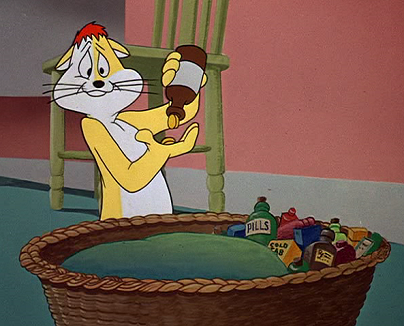
Claude, the world's most neurotic cat. 

This cartoon series marked the turning point in Chuck Jones career. Most of Jones's cartoons and other Looney Tunes of the the 1930s and early 1940s were far more 'cutesy' in nature (save for the occasional wild card by Bob Clampett).  Jones shorts, in particular, would tend to come across as Disney-like. For instance, his first cartoon star, Sniffles the Mouse, was a naive and sweet character who would later fad into obscurity, in favor of more funny slapstick characters.

While Jones's early shorts were praised for their elaborate animation, audiences found them very generic. Thus, Jones created the short, "The Dover Boys" (1942), the cartoon that taught him how to be funny. While "The Dover Boys" is well remembered by animation fans today, many overlook Jones's equally important cartoon series featuring Claude the Cat and Hubie and Bertie. The series was short lasting, but very important in forming the trademark Looney Tunes style. It was one of the first series to be purposely funny, rather than cute. It was the polar opposite of typical Disney shorts. Fast paced action, physical humor, and over the top gags hence forth became associated with Looney Tunes.

The largest impact that Claude and Hubie and Bertie had on Jones was it defined his great usage of characterization. Each personality in this series is distinctively defined and believable. Claude is a cowardly and nervous, extremely sensitive to his surrounding and a pill popper. He would much rather spend most of his day sleeping without worries. However, Claude is constantly tormented by two mice, Hubie and Bertie, who try to move into his home. Hubie is the smarter of the two and comes up with schemes to fool Claude or take advantage of his fearful nature. Bertie is....not. Even though Claude is the antagonist, the audience often ends up feeling sorry for him, yet cannot help laughing at the antics of two mice. 

4. Rooty Toot Toot (1952): Pioneering Limited Animation and a Bold New Style


UPA at its best.

John Hubley was an animator who formally worked at Disney. After seeing the Russian animated feature, The Tale of Czar Durandai (1934), he became inspired by its unique art style. Hubley then left Disney during The Animator's Strike of 1941. He then helped found the studio UPA (United Productions of America), famous for pioneering limited animation and cartoons such as Mr. Magoo and Gerald McBoing-Boing.  

Hubley's "Rooty Toot Toot" best exhibits UPA's motto of 'less is more.' Each scene has a distinctive color scheme to emphasize the mood. The drawings are stylized and simple but manage to convey each character's personalities perfectly. The plot is more 'adult' than what many people think of when it comes to cartoons. (Actually, many theatrical cartoons were for more mature audiences. It wasn't until the arrival of television and parental watchdogs overacting that cartoons were deemed 'kid's stuff.') "Rooty Toot Toot" is a courtroom drama retelling the song, "Frankie and Johnny." Frankie is on trial for shooting her lover, Johnny, who was with another woman. She is defended by the lawyer 'Honest' John. With it's jazzy soundtrack, unconventional storyline, and black humor, "Rooty Toot Toot" is a truly inspired piece of cinema.  


"Frankie and Johnny were sweethearts..."

5. The King and the Mockingbird (1952 - 1980): Animation as a Moving Art   


A classic in French cinema.

Paul Grimault was to France what Walt Disney was to American animation. But unlike Walt, Grimault's films tended to be far more lyrical in style, satirical, and contained little to no dialogue, being primarily a visual experience. His unique style has influenced countless contemporary French animators (most notably Sylvain Chomet), and Japanese animators Hayao Miyazaki and Isao Takahata. He tended to animate simplistic yet appealing drawn characters contrasted with elaborately detailed backgrounds. Grimault's works also contained social commentary and moral issues, proving that animation can be enjoyed by any person, of any age. Early on in his career, Grimault made many widely acclaimed shorts, including The Scarecrow (1943) and The Little Solider (1947).

In the 1948, Grimault began to work on his planned masterpiece, the feature length The King and the Mockingbird (Le Roi et l'osiseau). However, Grimault lost control of the film and it was shown, incomplete and against his will in 1952. It wasn't until 1967 that Grimault got his film back, and not until 1980 that it was finally released as originally intended! (Barely beating out the time The Thief and the Cobbler's production took!)

 The King and the Mockingbird is a fascinating film. Loosely based off of the fairytale The Shepherdess and The Chimney Sweep, it is the story of a very egotistic king and his rivalry with a mockingbird (who is upset with the King for shooting his wife). The King is a lonely and ugly man who finds comfort in creating large monuments of himself and is love with a painting of a shepherdess. One night, the paintings of the Shepherdess and the Chimney Sweep come to life and escape. They are then pursued by the painting version of the King (who disposed the real king) and are aided by the Mockingbird. This film is a work of art and gives insight on both sides of human nature. It is absolutely criminal that the completed version was never released in the US. All we have is a worn-out public domain copy of the 1952 version.


A Japanese trailer for the film.