Showing posts with label films. Show all posts

Wednesday, January 28, 2015

The Red Dragon & the Woman in the Sun: Symbolism in Manhunter


Let's take an in-depth look at one of the most unique thrillers of the 1980s.

In the 1986 film, Manhunter, Michael Mann makes heavy use of color saturation, a variety of camera angles and other visuals to convey a heightened sense of mood and tension. All of these elements give greater insight into the movie’s theme and its character development. This is especially apparent during the scene where Rheba McClane spends the night over at Francis Dollarhyde’s house. Even though the scene only lasts for about six and a half minutes, it is a crucial part of the film because it helps the audience understand and sympathize with Dollarhyde, despite that he is a serial killer and Manhunter’s primary antagonist. At the same time, however, there is a sense of disease and apprehension that looms over the relationship between Dollarhyde and Reba.


Wednesday, October 16, 2013

Ub Iwerk's The Headless Horseman VS Disney's Sleepy Hollow

It's that time of year again. Carved pumpkins line people's porches and parents grudgingly buy big boxes of candy while their kids decide what to wear for Halloween. Animated cartoons and films have long been made centered around the holiday. In fact, just last year three titles were released alone (Hotel Transylvania, Frankenweenie, and ParaNorman). However, very few such animated films have reached the acclaim of Disney's version of Sleepy Hollow, which curiously was adapted by Disney's rival, Ub Iwerks, over ten years earlier as a theatrical short.


A poster for the 1934 Comicolor short.


A poster for the better known 1949 film.

Because the two films were based on the same story by Washington Irving and were made by staff associated with Disney they have several similarities. But, it is probably easier to notice their differences. The Sleepy Hollow segment was part of Disney's 'package film' series and runs at half an hour, whereas Iwerks's version is under ten minutes long. Since Iwerks's short was made in the 1930s, it utilizes the old school, bouncy rubber hose technique. Its color pallet is also quite limited, since Disney was the only animation studio with the rights of using the three color Technicolor process up until 1936. Instead, the short utilizes the two color Cinecolor process, as did most other cartoon companies at the time.

The Adventures of Ichabod and Mr. Toad is far more sophisticated in many ways. Since the movie was made right before Disney released Cinderella, its first 'true' feature since 1942, the animation is fully released and very fluid. It's moody use of Techicolor and perspective greatly heightens the contrasting scenes at Katrina's dinner party and Ichabod's encounter with the Headless Horseman. Ichabod also makes heavy use of dialogue (narrated and sung primarily by Bing Cosby), whereas Iwerks was more comfortable using pantomime and sight gags to get his message across. Thus, the characters in the Disney version are given more of a back story and fleshed out, while Iwerks manages to establish the basics allowed within the short runtime of his cartoon. (Interestingly enough, Ichabod and his rival, Brom Bones, look similar in both films, but Katrina does not. She is noticeably bigger in the 1934 incarnation, which is closer to the original source material. However, Disney's Katrina resembles a more aloof Cinderella.)


Iwerks's Brom Bones, Katrina Van Tassel, and Ichabod Crane. 


Disney's version.

As for the Headless Horseman himself, Disney and Iwerks handle the character rather differently. Both of the horsemen are introduced as menacing figures. Iwerks establishes this using his multiplane camera (which would later be adopted and refined by Disney after Iwerks returned to the studio). The camera adds a sense of depth as the Horseman races across the screen, accompanied by a haunting score by Carl Stalling (who later became famous for composing various Looney Tunes shorts). However, the mysteriousness of the Horseman is quickly pushed aside for laughs. The figure is revealed to be Brom Bones, and Ichabod later crashes Brom's and Katrina's wedding by dressing as the Horseman.

In The Adventures of Ichabod and Mr. Toad, none of this happens. Although the Horseman is a legendary figure and is implied to be Brom, the events that occur after Ichabod encounters the Horseman are left for the audience to interpret. Ichabod's fate is never fully revealed after his disappearance, giving the audience the choice whether to believe the legend or not.


Iwerks introduces the Headless Horseman via the multiplane camera.


So does Disney, in a more sinister way.

So which film is 'better?' It is really hard to make a fair comparison, since they were made at different points in history and have different intents in terms of entertainment. Both films are historically significant and have very effective musical scores. Those looking for strong character development and a good scare will probably prefer the Disney version. However, anyone simply wanting some light hearted entertainment and a quick laugh will like Iwerks's short.

What do you think? Watch the two films and compare them yourself.


The complete short.


Click here to watch the segment of Disney's film (or else Ichabod will eat his hat). 

Saturday, June 15, 2013

The Lasting Legacy: Post-Modern Examples of Rubber Hose


Despite being largely abandoned by the late 1930s, rubber hose animation remains commonly tributed and occasionally even employed.  

Why does rubber hose style animation continue to be used once in a while? It certainly has not been the norm since the mid-1930s. But there is something appealing about the free form movements, exaggerated expressions, fluid simplicity, and bizarre plotlines of early American cartoons. Some of the longest running cartoon series and most famous characters originated over 70 years ago, and still continue to influence pop culture today (i.e: Felix the Cat, Betty Boop, Popeye, Mickey Mouse). Animators John K and Michael Sporn, although having differing tastes, have often praised the early innovations (and boundless creativity) of old cartoons, on their blogs. Likewise, these older cartoons are becoming more commonly seen again, after being taken off of TV airings for many years, thanks to video sharing sites on the internet, such as Youtube and Blip. Rubber hose may be outdated or be deemed primitive, but when used creatively it can still prove entertaining. For this reason, animation today continues to make references to the style, and certain modern TV series and movies draw great influence from it as well.

Of course, most modern examples of rubber hose are done purposely to invoke nostalgia and for appealing to animation junkies. Recent episodes of The Simpsons and Futurama have parodied the style. The lead characters in The Animaniacs (1993-1998), were 1930s cartoon stars who had been locked away in the Warner water tower for many years, and were initially created to replace WB's bland character, Buddy. Foxy, Roxy, Bosko, Honey, and Goopy Geer were also featured in another Warner Brothers cartoon, Tiny Toon Adventures (1990-1995), in the episodes "Two-Tone Town'' and "Fields of Honey." Reboots of long lasting cartoon characters, utilizing a more retro rubber hose style and modern sensibilities, have also been made. The Twisted Tales of Felix the Cat (1995-1997) was certainly a far wilder take on the franchise than the more kiddy '60s cartoons. Disney has recently produced two productions based off of the classic version of Mickey Mouse: "Get a Horse" (a short in the vein of the character's original cartoons), and a new TV series, blending rubber hose with newer styles, set to premie on Disney Channel.


The Animaniacs's lead characters were inspired by early cartoon characters, and the show combined classic conventions with modern humor. 


Recently, Disney announced that it will be releasing new Mickey Mouse shorts more in vein of the character's original interpretation.


Not all studio output consists of simply tributes or reboots of old theatrical shorts, however. Sometimes rubber hose animation may be used for humorous effects. Elastigirl from The Incredibles (2004), has the superpower of being extremely stretchy and is able to contort her body in a wide variety of odd ways. While being based on comic book characters such as Mr. Fantastic of the Fantastic Four and Plastic Man, Elastigirl certainly owes some of her movements to the tradition of the loose limbed animation from yesteryear (as does the anime character, Monkey D. Luffy, from One Piece). Spongebob Squarepants, being a well...sponge can also sometimes move his body in weird ways and has noodly arms and legs. Perhaps the best known of example of 'modern rubber hose', would be Adventure Time. All of the show's characters possess tube-like limbs and are simply drawn. Adventure Time's frequently bizarre, sometimes rather unsettling storylines also seem to be heavily influenced by the works of the Fleisher Brothers and Ub Iwerks. Due to Adventure Time's popularity (and perhaps as a way to make animation fluid enough for TV but keep the budget under control), several other recent series have adopted the usage of rubbery physics, including Regular Show, Sanjay and Craig, and the upcoming Wonder Over Yonder.


Strange and loose limbed, Adventure Time is clearly influenced by the physics of rubber hose. 

In the independent film making crowd, rubber hose has also been utilized by many different people. Sylvain Chomet's The Triplets of Belleville (France, 2003), featured a memorable sequence in its beginning were the titular characters and certain period singers and stars are drawn in an old fashioned black and white style, which is perfectly appropriate given that the triplets were music hall singers from the 1930s. The ska band Squirrel Nut Zippers made an excellent homage to the Fleisher Brothers in their music video for the song, "Ghost of Stephan Foster" (1999). A short by animator Fernando Miller, "Flea and Fly in City Troubles" (2012), was made to look like an old, worn print of a theatrical cartoon for a rather different purpose. It is used to boldly portray the real world issues of poverty and homeless childern living in the streets of Brazil. Nina Paley also seems to like rubber hose animation. The lead of her film, Sita Sings the Blues (2008), seems to be modeled off of Betty Boop. Sita also sings Annette Hanshaw jazz numbers in a similar way to how many 1930s characters incorporated popular songs into their plots.


If the above don't scream retro, nothing does.

Rubber hose animation hugely impacted the development of anime, particularly through Osamu Tezuka ('the God of Manga'), who brought us such classics as Astro Boy, Jungle Emperor Leo, Princess Knight, Black Jack, and Phoenix. Tezuka had a fondness of creating young characters with large eyes and small noses, and sometimes wrote rather strange or wacky storylines to counterbalance his more dramatic and serious ones. These elements remain fairly common in modern anime today. Tezuka even outright tributes rubber hose and plays with the audience's perception of film reality in his experimental short, "Broken Down Film" (1980). The influence of American cartoons on Japanese animation can be seen from very early on. For instance, the anime shorts "Ugokie Ko Ri No Tatehiki" (1933) and "The Routing of the Tengu"(1934), show a unique glimpse at the blending of Western and Eastern artistic styles. The video game character Sonic the Hedgehog seems to be heavily based on Western funny animals, having arms and legs that move with little regard to articulation, large conjoined eyes, white gloves, and shoes. Even Hayao Miyazaki acknowledges his love for Fleshier Studios and considers its existence one of his inspirations for becoming an animator. Miyazaki distributed the company's last film, Mr. Bug Goes To Town (1942), through the Studio Ghibli Museum library and his Laputa robot owes a lot to the Superman short, "The Mechanical Monsters" (1941). In Porco Rosso (1992), Miyazaki makes a tribute to Fleshier's rubber hose fare, when Porco is watching a cartoon in a theater that could easily be mistaken for a 1930s short.


Osamu Tezuka was clearly influenced by the style of early American cartoons.


Miyazaki is a huge Fleischer Brothers fan. Here, he tributes them in a clip from Porco Rosso

Saturday, April 13, 2013

The 10 Stupidest Mockbusters EVER

Mockbusters are the bootleg equivalents of the movie world, except that they manage to tightrope around legal accusations. They exploit the ignorance of certain moviegoers (parents who don't care what their kids watch, senile grandmothers, etc) into buying knockoff versions of blockbusters. Most mockbusters are released around the same time a popular film is in theaters or just before it hits the home video market. They are cheaply made and often have little to do with the film they are piggybacking save for the basic premise. Unfortunately, mockbusters are doing better than ever due to sites such as Netflix and Hulu.

Just how bad are they? Well....they are often reviewed by shows such as Mystery Science Theater 3000 and are quickly becoming more infamous than B movies, which should set off red flags. So to inform people of the awfulness of mockbusters, here are ten of the worst I have had the (dis)pleasure of watching. 'Enjoy!'

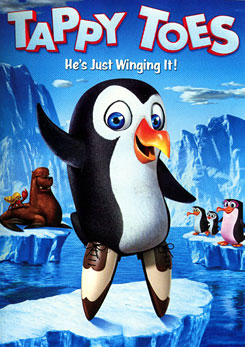
10. Tappy Toes 


Happy Feet was already a cliche enough film about preachy, singing penguins. This movie doesn't even have an IMB page, presumably to keep people from leaving bad reviews on it. Brought to you from the 'brilliant' company, Renegade Animation (which states on its website to bring you "smart, funny, and always original" productions), Tappy Toes is not even what it appears to be on the cover. The film is not done in CGI, but animated in cheaply in Flash. It is about a dancing penguin who is raised by two Skua Birds who eat their own boogers. Seriously. 

9. Age of the Hobbits


Technically, this movie has been renamed Clash of the Empires because it actually sounded similar enough to Peter Jackson's film to provoke a lawsuit. Given that it was released by The Asylum, this perhaps is not too surprising. The company's founder David Michael Latt once said, 

 "I'm not trying to dupe anybody. I'm just trying to get my films watched. Other people do tie-ins all the time; they’re just better at being subtle about it. Another studio might make a giant robot movie that ties into the Transformers release and call it Robot Wars. We’ll call ours Transmorphers."

What an honest man! His vast insights sure make appreciate the artistry and acting in Age of the Hobbits a lot more!

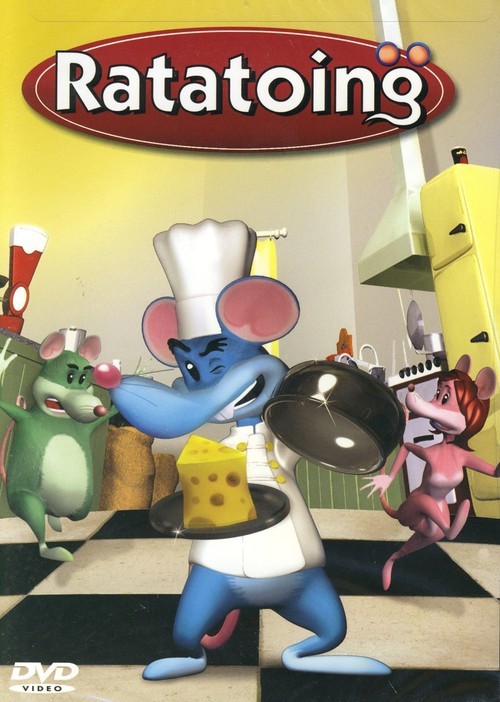
8. Ratatoing


Video Brinquedo is the Brazilian animation equivalent of The Asylum. All of its productions bare an uncanny resemblance to several Dreamworks, Disney, and Pixar films. Ratatoing is perhaps the most infamous of all due to its awkward dialogue and very bad animation. So much so, that it was even parodied on a Cartoon Network show. Currently, Ratatoing has a three percent approval rate on Rotten Tomatoes. Impressive. 

7. The Little Panda Fighter


The Little Panda Fighter is another Video Brinquedo monstrosity. Instead of wanting to become a kung fu panda, however, this one wants to be ballerina... and spends much of his time creepily staring at the audience like on the box art above. He also fights an evil Care Bear at one point. One thing is for sure, after watching this film, anyone can learn to better appreciate the animation that comes out of well known studios (and how they avoid the uncanny valley). 

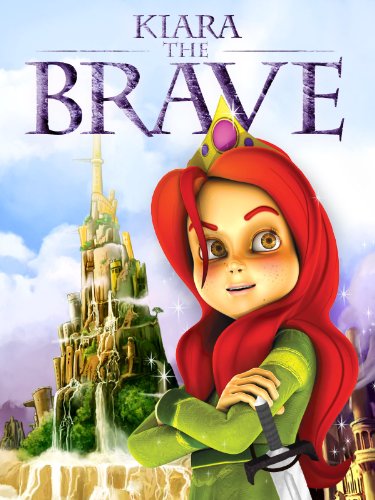
6. Kiara the Brave


Don't be fooled. This movie has very little at all to do with the similarly named Pixar film. It is actually an Indian film called Super K repackaged to look like Brave. The plot follows a boy with superpowers and his quest to save the galaxy. Too bad for all the little girls who were hoping to see a movie about a plucky princess! The Youtube tailer has its comments disabled, so they can not even voice their disappointment. 

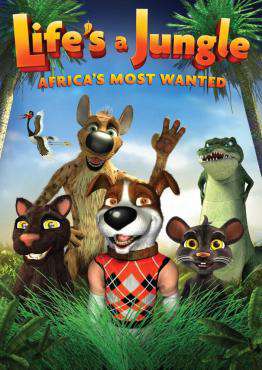
5. Life's a Jungle


Here is film which in no way resembles Madagascar! Still not convinced? Well, it comes with a free downloadable activity kit. Also, here's a fun game kids! Let's play how to spot the uncanny valley again! Note: We are not responsible for any nightmares this production may cause. 

4. The Secret of Mulan


Disney's Mulan and Pixar's A Bugs Life came out during the same year. So somebody decided to release a cartoon with both of them combined. In this version, Caterpillar Mulan fights an evil Hun cockroach and must win the affection of a butterfly prince. The screenwriter's credits include the likes of Jem, Dork Hunters from Outer Space, and Kong: The Animated Series

3. Sunday School Musical


What's worse than High School Musical? The Asylum's Sunday School Musical! Made on the high budget of $8,100, it is guaranteed to offend Christians everywhere. Critics on IMDB are saying, "If a movie is still awful drunk, you know it's a bad film" and, "It's a good laugh if you can appreciate it for what it is - total crap".   

2. The Amazing Bulk


Easily the most unintentionally hilarious mockbuster on this list, The Amazing Bulk fails on every level to be scary or suspenseful. It's a hybrid between a superhero story and Dr. Jekyll and Mr. Hyde. The producers were so lazy that all of the CGI props stick out like a sore thumb and the green screen is the worst in a motion picture that I have ever seen. Don't get me started on the acting. It looks like a parody on Saturday Night Live


Prepare to laugh or cry, you cannot escape the horribleness of this movie. 

1. Titanic the Animated Movie (Both Versions)


The two animated Titanic movies have become semi-legendary on the internet due to how absolutely bonkers they are. The first one, Titanic: The Legend Goes on, involves a rapping dog, Yiddish mice, and love interests that have about three lines of dialogue a piece. The second, The Legend of the Titanic, is even worse. Here the titanic is not sunk by an iceberg, but by gangster sharks and a giant octopus. It also has dolphins that can communicate with people by crying moonbeams. In both versions, none of the characters die except for the villains. This is so insulting to all of those who died on the real Titanic. It would be like if Disney decided to make an Anne Frank movie.


There is a rapping dog on the Titanic. This is the real tragedy. 

Sunday, February 10, 2013

The Most Influential Animations You Never Heard Of (Part 1)

Animation's history spans over one hundred years. People have long been fascinated by the illusion of movement. Many film enthusiasts are aware of this history and can name several innovative breakthroughs (like the development of the zoetrope, cels, xerography, and CGI). Even the average person is aware of influential works such as Steamboat Willie (1928), Snow White (1937), Astro Boy (1963), My Neighbor Totoro (1988), and Toy Story (1995). Yet, there are many works that are just as historically important which are often sorely overlooked. Below, listed in chronological order, are just a few of such animations from various countries over the years.

1. Koko the Clown (1918-1929): Early Usage of the Rotoscope and Revolutionizing Animation 


A typical Koko cartoon.

Koko was the first cartoon star of the Fleischer Studios (famous for Popeye, Betty Boop, etc). These cartoons were among some of the first to use animated characters interacting with live action actors. Max Fleischer himself, would often appear at the start of the shorts and draw Koko and his dog sidekick, Fitz, into being. Often Koko and his dog would get into trouble, go on adventures in far away lands, or play a prank on their creator. The series was also the first to use the technique of rotoscoping, the tracing of live action footage, for more realistic human animation. Like many of the early animated shorts of the time period, the setting was often very surreal and made heavy use of sight gags.

Koko was popular enough to star in a second series, "Song Car-tunes" in 1924. This series was the first to use the famous 'follow the bouncing ball' sing-along technique. Koko would later make appearances in a few Betty Boop cartoons, most notably in "Snow White" (1933) and "Ha Ha" (1934). The cartoon above is "Koko's Earth Control" (1928).

2. The Films of Ladislas Starevich: The Father of Stop-Motion Animation


 One of the most overlooked animated films ever made.

Ladislas Starevich was a true pioneer in stop-motion animation. His style has been hugely influential on many directors such as Tim Burton and Terry Gilman. Starevich's attention to detail, social commentary, bizarre visuals, and fantastical plots inspired an entire generation of animators.

Born to Polish parents in Russia, Starevich had a passion for studying zoology. In 1910, he was named director of the Museum of Natural History in Kovno, Lithuania. Because he was unable to naturally photograph the lives of certain species of insects, Starevich began creating puppet animations using dead insects. His first film, The Beautiful Lukanida (1910) was the first ever to use puppet animation. He gradually started to make films with plots and relatable characters, such as The Cameraman's Revenge (1912) and The Insects Christmas (1913).

After WWI, Starevich moved to France. Here he began to create films utilizing sound and actual puppets (not insects). Two of his most acclaimed works were The Mascot (1934) and The Tale of the Fox (1937). The Mascot was an half an hour short starring Duffy, a small stuffed dog, who must retrieve an orange for a sick girl and winds up at a devil's ball. The short was successful enough to be followed by three films about Duffy.

The Tale of the Fox was Starevich's masterpiece. It was the sixth animated film ever made and the second to utilize puppets and sound (the first being The New Gulliver [1935]), beating out Snow White by eight months. It's sophisticated use of motion-blur techniques and heavy use of dialogue made The Fox a true landmark in film. The plot of the film involves a wily fox who must be trialled before the King for his constant pranks. Below is a small clip from The Tale of Fox featuring the Queen being wooed by a minstrel cat.


The animation is utterly amazing to this day.

3. Claude the Cat & Hubie and Bertie (1943 - 1951): The Cartoon Series That Broke the 'Disney' Mold.


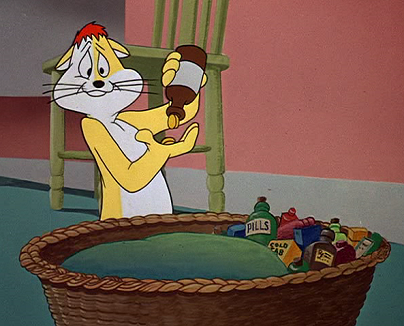
Claude, the world's most neurotic cat. 

This cartoon series marked the turning point in Chuck Jones career. Most of Jones's cartoons and other Looney Tunes of the the 1930s and early 1940s were far more 'cutesy' in nature (save for the occasional wild card by Bob Clampett).  Jones shorts, in particular, would tend to come across as Disney-like. For instance, his first cartoon star, Sniffles the Mouse, was a naive and sweet character who would later fad into obscurity, in favor of more funny slapstick characters.

While Jones's early shorts were praised for their elaborate animation, audiences found them very generic. Thus, Jones created the short, "The Dover Boys" (1942), the cartoon that taught him how to be funny. While "The Dover Boys" is well remembered by animation fans today, many overlook Jones's equally important cartoon series featuring Claude the Cat and Hubie and Bertie. The series was short lasting, but very important in forming the trademark Looney Tunes style. It was one of the first series to be purposely funny, rather than cute. It was the polar opposite of typical Disney shorts. Fast paced action, physical humor, and over the top gags hence forth became associated with Looney Tunes.

The largest impact that Claude and Hubie and Bertie had on Jones was it defined his great usage of characterization. Each personality in this series is distinctively defined and believable. Claude is a cowardly and nervous, extremely sensitive to his surrounding and a pill popper. He would much rather spend most of his day sleeping without worries. However, Claude is constantly tormented by two mice, Hubie and Bertie, who try to move into his home. Hubie is the smarter of the two and comes up with schemes to fool Claude or take advantage of his fearful nature. Bertie is....not. Even though Claude is the antagonist, the audience often ends up feeling sorry for him, yet cannot help laughing at the antics of two mice. 

4. Rooty Toot Toot (1952): Pioneering Limited Animation and a Bold New Style


UPA at its best.

John Hubley was an animator who formally worked at Disney. After seeing the Russian animated feature, The Tale of Czar Durandai (1934), he became inspired by its unique art style. Hubley then left Disney during The Animator's Strike of 1941. He then helped found the studio UPA (United Productions of America), famous for pioneering limited animation and cartoons such as Mr. Magoo and Gerald McBoing-Boing.  

Hubley's "Rooty Toot Toot" best exhibits UPA's motto of 'less is more.' Each scene has a distinctive color scheme to emphasize the mood. The drawings are stylized and simple but manage to convey each character's personalities perfectly. The plot is more 'adult' than what many people think of when it comes to cartoons. (Actually, many theatrical cartoons were for more mature audiences. It wasn't until the arrival of television and parental watchdogs overacting that cartoons were deemed 'kid's stuff.') "Rooty Toot Toot" is a courtroom drama retelling the song, "Frankie and Johnny." Frankie is on trial for shooting her lover, Johnny, who was with another woman. She is defended by the lawyer 'Honest' John. With it's jazzy soundtrack, unconventional storyline, and black humor, "Rooty Toot Toot" is a truly inspired piece of cinema.  


"Frankie and Johnny were sweethearts..."

5. The King and the Mockingbird (1952 - 1980): Animation as a Moving Art   


A classic in French cinema.

Paul Grimault was to France what Walt Disney was to American animation. But unlike Walt, Grimault's films tended to be far more lyrical in style, satirical, and contained little to no dialogue, being primarily a visual experience. His unique style has influenced countless contemporary French animators (most notably Sylvain Chomet), and Japanese animators Hayao Miyazaki and Isao Takahata. He tended to animate simplistic yet appealing drawn characters contrasted with elaborately detailed backgrounds. Grimault's works also contained social commentary and moral issues, proving that animation can be enjoyed by any person, of any age. Early on in his career, Grimault made many widely acclaimed shorts, including The Scarecrow (1943) and The Little Solider (1947).

In the 1948, Grimault began to work on his planned masterpiece, the feature length The King and the Mockingbird (Le Roi et l'osiseau). However, Grimault lost control of the film and it was shown, incomplete and against his will in 1952. It wasn't until 1967 that Grimault got his film back, and not until 1980 that it was finally released as originally intended! (Barely beating out the time The Thief and the Cobbler's production took!)

 The King and the Mockingbird is a fascinating film. Loosely based off of the fairytale The Shepherdess and The Chimney Sweep, it is the story of a very egotistic king and his rivalry with a mockingbird (who is upset with the King for shooting his wife). The King is a lonely and ugly man who finds comfort in creating large monuments of himself and is love with a painting of a shepherdess. One night, the paintings of the Shepherdess and the Chimney Sweep come to life and escape. They are then pursued by the painting version of the King (who disposed the real king) and are aided by the Mockingbird. This film is a work of art and gives insight on both sides of human nature. It is absolutely criminal that the completed version was never released in the US. All we have is a worn-out public domain copy of the 1952 version.


A Japanese trailer for the film.

Tuesday, January 29, 2013

The Influence of German Expressionsim on American Cinema


Sunrise (1927), an example of an American film by a German director.

There is no doubt that the one of the greatest art forms to come out of the 20th century is movie making. Virtually, anybody alive today has a favorite movie or at least seen numerous films throughout their lifetime. But very few know about how, in the early, silent years of cinema, Hollywood was changed forever by the influence of German filmmakers.

Throughout the mid 1910s to 1920s, the American film industry focused mainly on only two main genres, action/adventure films (which were mainly based off historical events or novels) and comedies. Popular Hollywood films  at the time were: D.W. Griffith’s controversial, but highly influential Birth of A Nation (1915); the foreign fantasy, The Sheik (1921);  The Mark of  Zorro (1920) and The Thief of Baghdad (1924). But comedians (like Charlie Chaplin, Buster Keaton, Harold Lloyd) and comedic cartoons (such as Felix the Cat and Oswald the Lucky Rabbit) arguably met the widest success. 


Charlie Chaplin, one of the most famous American silent Stars.


Felix the Cat was to cartoons what Chaplin was to American cinema. 

However, filmmaking in Europe focused less on action-adventure and comedic routines than Hollywood did, and more on experimentation, visuals, emotion, and the flaws of human nature. This is particularly true in the case of German Expressionism- a term used to describe the unique take of  German filmmakers during the era. The movement was characterized by its usage of elaborate sets and exaggerated acting to emphasize mood, abstract scenery, high contrast lighting, and had a tendency to tackle darker subject matter. The plots and stories of the Expressionist films often dealt with madness, insanity, betrayal, and other “intellectual” topics. Some of the most famous expressionist films are: The Cabinet of Dr. Caligari (1920), The Golem (1920), Nosferatu (1922), Faust (1924) Metropolis (1927), Pandora’s Box (1929), and M (1931).


A typical German Expressionist Film: moody, experimental, elaborately made, and dark.

The Cabinet of Dr. Caligari is a bizarre frame story in which a man retells his experience with a creepy carnival overruled by the hypnotist, Caligari, and the sleepwalker Caligari controls in order to carry out murders. It was one of the first movies to feature a twist ending (the narrator is revealed to be mentally insane). This film was hugely influential on many directors, like all expressionist films, but most notably Tim Burton. This can be seen in Burton’s fondness of using outlandish and geometrical sets, the resemblance of Edward Scissorhands to Cesare (the sleepwalker), and the dreamlike atmosphere in his films. 


It's easy to see the influence of this film on Tim Burton's style.

The Golem, Nosferatu, and Faust are arguably the expressionist films most responsible for creating the horror genre. All of three dealt with the supernatural, malicious beings or monsters, and featured dark and/or tragic storylines. The Golem was about rabbi creating a clay warrior to protect the Jews from being prosecuted, but his creation goes out of control. (This is pretty eerie considering that the Holocaust occurred twenty years later.) Nosferatu was one of the  earliest vampire films, heavily borrowed from Dracula, and linked the legend to the spread of the black plague. Faust, which was also adapted from a classic novel, was about an alchemist conflicted by his own selfish ambitions motivated by the Devil and his desire to do good. The effects of these films were felt immediately as Hollywood began releasing films like The Phantom of the Opera, The Hunchback of Notre Dame, and Frankenstein over the next several years.


Nosferatu is a vampire.  


This thing is not.

Metropolis is the story of a dystopian future were the elite live in luxury at the expense of  the underclass workers who live below surface. When a woman named Maria tries to bring peace between the exploited workers and the elite, a robot duplicate is given her image so it can manipulate the masses and crush any chance of rebellion. It was the most expensive silent film costing over 7 million Reichmarks which would be about $200 million today. Metropolis’s influence was huge. It is widely considered to be the first major (and most significant) science fiction film and featured ground-breaking special affects. Even today it has continued to be used as inspiration where you would least expect. For example, strangely enough, Lady Gaga. The name Lady Gaga actually comes from a music video by Queen entitled “Radio Gaga” which uses footage from Metropolis. Lady Gaga’s outlandish costumes also seem to be sometimes inspired by the Maria robot or the film’s bizarre dance scene. 


Marvel at how the miniatures were made.


Words can not describe how groundbreaking Metropolis was. 

Among the last German expressionist films made were Pandora’s Box and M. Both were less abstract in nature, set in contemporary times with a crime backdrop, and focused more on flawed, tormented characters with questionable motives. Pandora’s Box was about a woman whose selfish, seductive behavior ignites jealously in men causing her to be accused of manslaughter when one of her lovers murders another man. M featured a detective trying to track down a troubled child murderer. 


Pandoras' Box and M are perhaps the most Film Noir-like of German films.

By the end of the 1920s, the German film industry became increasingly regulated as the Nazi Regime rose to power. Many artists and filmmakers fled to Hollywood so they could continue to keep making films (and many of them also happened to be Jewish). They brought with them their unique visions and created a new major movement in Hollywood, Film Noir. Film Noir was also made in response to The Hays Box Office Code, which regulated the film industry causing many 'safe' films to made throughout the 1940s and 50s (i.e. musical romantic comedies). Film Noir movies were crime dramas shot in black and white, featured characters with questionable motives, femme fatales, and dramatic lighting. (Sound familiar?) This in turn eventually changed the whole Hollywood film industry by causing The Hayes Box Office Code to loosen its restrictions and eventually be replaced by the film rating system. Because German Expressionism influenced Film Noir it also influenced countless directors  (ranging from Orson Welles, to Alfred Hitchcock, to Ridley Scott) which made way for the variety of films we experience in modern cinema today.


Typical Film Noir movies. Notice how similar they looks to German Expressionist Films!


Alferd Hitchcock studied film in Germany for a while.

Thus, German Expressionist Films are hugely important to many aspects of film today. The genres Horror and Film Noir owe their origin to it. Expressionism, through influencing Film Noir, eventually resulted in the fall of the Hays Box Office Code. Countless directors also owe some of their success to techniques they picked up from German filmmakers. So next time you watch a movie, check to see if you can spot any traits associated with German Expressionism. You might be surprised.


  Citizen Cane, Sunset Blvd, The Godfather, Blade Runner, and even The Dark Knight are just a few examples of films influenced by the long legacy of German Expressionism.


Friday, January 11, 2013

Animated Films that Never Were (Don Bluth Edition)

Making an animated film is a long and complicated process. Many films spend years, sometimes even decades in development. ( In an extreme case, Ricard William's The Thief and the Cobbler spent about 30 years in limbo before it was released in 1993.) Here are some films by renowned animator, Don Bluth, that sadly never got to see the light of day. Bluth often struggled with finical troubles, particularly after his studio tanked in the mid 1990s. Here's a small glimpse at what could have been.

The Little Blue Whale:


Satyrday:


The Velveteen  Rabbit:


East of the Sun, West of the Moon: 
was meant to be released after the Secret of NIMH (1982), but but the union went on strike for 73 days.