Showing posts with label Soyuzmultfilm. Show all posts

Wednesday, August 21, 2013

Nu Pogodi! (Review)

Directors: Vyacheslav Kotyonochkin (episodes 1-16), Vladimir Tarasov (episodes 17 & 18), Aleksey Kotyonochkin (episodes 19 & 20)

Company: Soyuzmultfilm

Year: 1969 - 2005

Country: Russia (Soviet Union)


What happens when a Western style chase cartoon meets local culture?

For over forty years, Nu Pogodi! ('Well, Just You Wait!') has entertained families throughout Russia and Eastern Europe. It is indisputably the most popular cartoon series in that region. There are Nu Pogodi! plush toys, Nu Pogodi! bottle openers, Nu Pogodi! statues in public parks, and even Nu Pogodi! video games. The reason for its appeal is simple. Nu Pogodi! is a funny animal cartoon filled with many sites gags and humor, very much in vein of Tom and Jerry or Looney Tunes's Willy Coyote and Roadrunner shorts. Despite that Nu Pogodi! is quite similar to many slapstick Western cartoons (It's about an ever persistent wolf trying to catch a hare.), Vyacheslav Kotyonochkin claimed to have never seen in any American cartoons outside of Disney, until his son bought a VCR in 1987.

The series follows the various exploits of Volk (Wolf) and Zayats (Hare). Each episode takes place in an unique setting, where Volk chases Zayats while trying to avoid various obstacles while at the beach, skiing, or on passenger ship, etc. Some of these surroundings are distinctively Russian. For instance, episode 16 takes place in a land comprised of various folktales, and episode 20 is set in a dacha community. An another notable aspect of this show is that it contains very little dialogue, aside from the two characters saying each other's names and Volk uttering his trademark threat to Zayats, "Nu Pogodi!" Much more emphasis is thus able to placed on physical interactions between Volk and Zayats, their environment, and the occasional side character they encounter (such as a magician cat, an angry hippo, or a large female pig).

Interestingly enough, Volk, rather than Zayats, is the more developed character, despite being the antagonist. Zayats is very cute and young. He is naturally curious, but seemly ignorant about many dangerous situations. He often gets away from Volk just by mere luck and he rarely fights back. Volk, on the other hand, is actually more easy to relate to, as he gets far more screen time. Volk is a hooligan who constantly breaks laws, taunts police, smokes, and bears a large beer gut. His relationship with Zayats is rather obsessive. Volk is willing to seek work at a construction site, sneak into museums, and even enroll in the Olympics in order to capture Zayats. But despite that he is a constant trouble maker and often quite cocky (not to mention a bit of a coward), Volk is equally goofy and fun loving. He is also quite talented, being able to play the guitar, figure skate, and engages in the fine arts.

To keep things fresh, Volk and Zayats are occasionally shown to work together against a greater force or Zayats will save Volk from danger, only to be chased again. This is particular noticeable in episode seven where Volk and Zayats must plug a hole they made in the hull of a ship, and in episode 18 where Zayats lights a cigarette for Volk when the wolf is trapped in a large safe. Their relationship can even resemble that of a friendship, on occasion. This has led to a lot of confusion and fan speculation surrounding the show. Zayats is commonly mistaken as girl due to his long eyelashes and high voice. Volk often wears various shades of purple and pink. In episode 14, Volk visits Zayats in fancy clothes. He gives him flowers and brings a bottle of cider to share. Although this may seem like Volk is courting Zayats, giving flowers to another man in Russia is not unheard of. It is often done as sign of friendship and goodwill.
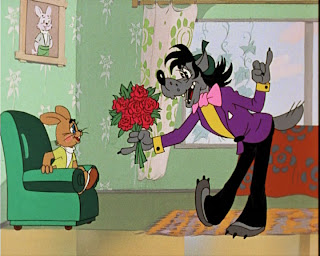

People are likely to take this frame out of context....It doesn't help that Volk is wearing a purple jacket.

While Nu Pogodi's creators were often scoffed at by fellow animators at Soymuzltfilm, it is still an enjoyable enough program. Sure, Nu Pogodi! isn't at the same level as Yuri Norstein's work or Roman Kachanov's films, but there is nothing wrong with that. Vyacheslav Kotyonochkin simply strove to create a series that entertained, to make people forget their troubles and laugh. Each installment of the series is self contained and can be watched in any order. Their is no effort to develop the characters any further than their ten minute run time will allow. Many of the episodes end rather abruptly, with Volk being carried away or separated from Zayats, vowing to capture the hare one day. The art direction and animation of the show is a bit privative by today's standards, but it manages to hold up will enough, thanks to the timeless character designs of the two leads. Nu Pogodi's use of music also helps add to its appeal. It features many popular Russian and Eastern European songs from the 1960s-80s throughout, often in synchronization with the animation. 


Volk and Zayats as they appear in the pilot and the first episode.

Unfortunately, the later episodes of the series are not as good as Vyacheslav Kotyonochkin's original sixteen installments. Vladimir Tarasov directed the next two episodes in 1994 and 1995, after the fall of the Soviet Union. Their budget woes are very apparent. The characters are frequently off model, the shorts' scores are less refined, and both of them are filled with excessive production placement from Nokia and AMT. Aleksey Kotyonochkin also took a crack at reviving his father's series in 2005, but his efforts manage to be even more offensive than Tarasov's attempt. His take on Nu Pogodi! is very juvenile. It is crammed with loud, obnoxious pop music and lacks narrative flow. It is also stiffly colored and rendered in Flash (which is a shame since the original pencil tests looked rather nice). Not to mention, Aleksey removed Volk's trademark cigaret and replaced with a more 'politically correct' lollipop!

All in all, Nu Pogodi! is light hearted fun fare. It is nothing ground breaking, but the series holds great appeal for many people who grew up in the Soviet Union. Nu Pogodi! is escapist entertainment, which is perfectly ok. So go ahead and watch the original series. If you are fan of American theatrical cartoons or animation about humanoid animals, chances are you will love it, just avoid the rather lackluster later episodes.


A typical Nu Pogodi! cartoon.

Rating: 3.5

Saturday, August 17, 2013

Movie Night: Rusalochka

As always, whenever I review an obscure work, I post it here on the blog if it is available from Youtube. Tonight's offering is the half an hour Russian film, Rusalochka (aka 'The Little Mermaid') from 1968. Dark, heartfelt, and expertly crafted, Rusalochka is quite unlike any other fairytale adaptation that you are ever likely to see. It is presented below in Russian audio with English subtitles.


Rusalochka / The Little Mermaid (Review)

Director: Ivan Aksenchuk

Company: Soyuzmultfilm

Year: 1968

Country: Russia (Soviet Union)


This fairly loyal adaption is an artistic spectacle to boot. 

For those only familiar with the Disney version of Han Christian Anderson's The Little Mermaid, the original version is considerably more brutal and tragic (but honest). It might also be surprising for some to learn that The Little Mermaid was, in fact, adapted twice before the Disney film debuted in 1988. Both versions, the 1968 short, Rusalochka, and the 1975 anime feature, are far more loyal to Anderson's tale and bare little resemblance to Ariel's undersea frolics. However, while the later is more well known, it is also less skillfully directed and cheaply animated. The 1968 film, on the other hand, is a overlooked piece of art.

Rusalochka opens in modern day Copenhagen, Denmark. Several tourists gather around the capital's famous mermaid statue, as a tour guide explains its significance. A fish in the water below the tourists scoffs at their foolishness, and then proceeds to tell about the doomed love of the mermaid.

Upon reaching her 15th birthday, the Little Mermaid is allowed to swim up to the surface above. As soon as she does, however, the Mermaid spots a young prince caught up in a dreadful storm. She admires the man's bravery and decides to save him, declaring that, "The beautiful and the brave should not perish." After the mermaid returns to the ocean, she decides that she wants to become human. Unfortunately for her, the Prince is found on shore by another women, whom he mistakes as his rescuer.


"These stupid people! They think that love exists and mermaids don't!" 

From this point on, Rusalochka's story differs greatly from Disney's The Little Mermaid. The mermaid runs away from home to meet the sea witch. The sea witch is not a malevolent character. She is just an eccentric, but wise individual. The witch warns that if the prince does not wed the mermaid, she will turn into sea foam. However, the mermaid has her mind set on love and exchanges her voice for a pair of human legs.

By the time the film reaches its climax, the mermaid must make the choice wether to not to release a storm on the prince, so that she can return to her sisters in the sea, or allow the prince to marry another. The unintentional consequences of the Mermaid's love become painfully apparent when she chooses to die rather than kill her lover, who is unaware of the whole ordeal (though he still cares for the Mermaid). But like the Prince, The Mermaid is also a flawed character. Although her bravery and perseverance are certainly admirable (She is willing to endure pain with every step she takes as a human), the Mermaid is quite naive and is easily swayed by her overwhelming emotions. The decisions that she makes aren't always smart, but the audience still feels for her when reality comes crashing down on her dreams.


Each scene utilizes a different style and color scheme to effectively convey mood.   

Rusalochka's animation style is also in stark contrast to that of Disney's. This is apparent at the very start of the film, which is shot in black and white, featuring animated characters alongside real life photo stills. After the introduction, Rusalochka switches over to a more complex, design based style. Although the animation may seem a bit jerky by modern standards, it is lovingly drawn in every frame. The look of the Rusalochka is heavily based upon Medieval paintings and frescos. Its artwork is filled with elaborate patterns and textures. Rusalochka's symphonic score also helps aid each scene's emotional resonance. Although the film contains little dialogue, it does not need extra talking to convey its message. Indeed, the film is primarily a visual experience.

Quite easily one of the most beautiful animated shorts ever created, Rusalochka manages to be a unique and faithful retelling of one of the world's most famous fairytales. Because it is so different than what most Western audiences are accustomed too, I hesitate to recommend it to someone uninterested in 'art house films', but I highly suggest that everybody else should seek out this mini masterpiece.   


How long did it take the animators to draw this single panel alone?

Rating: 4/5

Wednesday, August 7, 2013

Russian Masterpieces: Short Films from the Top of the World


Visually elaborate?  Possesses a dreamlike quality? Moves at a tranquil pace? It must be a Russian cartoon! 

Several Russian animated productions have been showcased on this blog before, including the work of Yuri Norstein, the ever popular Cheburashka series, and the 1957 film, The Snow Queen. Although the golden years of Soviet era animation are long gone and the former studio giant, Soyuzmultfilm, is plagued with problems, an occasional high profile product still comes out once in a while.

Truly, it's a shame that much of Russia's output from the 1950s through the 1980s is ignored here in the West, no doubt due to tense political misgivings between the country and the United States. Contrary to popular belief, the vast majority of Russian animation is not propaganda. It covers a wide variety of genres, ranging from family aimed fantasies to complex adult dramas. Most of this animation is highly lyrical in style, is artistically unique, and quite often contains social commentary. Interestingly enough, cartoon television series never really caught on in Russia (save for foreign exports) and animated features became increasingly less common in the second half of the 20th century. Short films were the preferred format, and it has been argued by some that animators living during this period perfected it.

Below, I have complied a list of ten notable (and often overlooked) Russian shorts from over the years with English subtitles. Enjoy! 

1. The Golden Antelope (1954)


This half an hour short practically plays out like a feature film. "The Golden Antelope" is notable for being directed by Lev Atamonov, who was one of the best known and most respected animators in his homeland. He was very active during the second era of Soviet animation. This era strove to reach a sense of 'fairytale realism' in a similar vein to that of Disney. (Later, Russia would begin to distinguish itself from Western cartoons by producing more ethically inspired works.) Unlike Disney, however, Atamonov's films tend to be closer to their source material. They have a crisp, simplified design to them which greatly influenced future anime directors, including Hayao Miyazaki.

"The Golden Antelope" is about an impoverished but kindhearted Indian boy. He helps an antelope escape from a band of hunters lead by a greedy raja. The raja wants to capture the antelope because she produces gold coins whenever she taps her hooves. The golden antelope is so grateful to the boy, that she promises to protect him. The antelope later must journey with the boy to the palace of the raja, after it is discovered that the boy hid her.

At its heart, "The Golden Antelope" is a moral story about the virtues of humbleness and how wealth can corrupt. Indeed, the raja is so selfish, that he initially considers giving the boy a gold coin, but then reconsiders and simply 'lets the boy live'. On the other hand, the boy shows no interest in obtaining riches. He is completely unswayed by the offers made by the raja and his servants. His friendship with the antelope and the compassion he shows to the other jungle animals ultimately is rewarded, whereas the raja almost becomes buried alive in coins, due to his insatiable greed.

2. The Mitten (1967)


After years of working at Soyuzmultfilm, Roman Kachanov, made his first big break with this charming little film. In "The Mitten", a girl desires to have a puppy of her own after watching various people play with their dogs outside on a snowy day. However, her mother is not so keen on the idea. The girl resolves the issue by imagining that her mitten is actually a small red puppy. She even enters her mitten into a dog contest, which results in an interesting turn of events.

This stop-motion short proves that one does not need to use dialogue (or have a high budget) to create something memorable. In fact, the short's simple yet focused plot has much more heart than many of this year's expensive blockbusters do. Its musical score and character interactions easily rival any of the material that Rankin / Bass put out during the same time period.

3. Ballerina on a Boat (1969) 


One of Lev Atamonov's later works, "Ballerina on a Boat" marked a significant departure in the style of Russian animation. As with many countries during the 1960s, Russian animation became increasingly more abstract in style and began dealing with a wider range of topics. The animation is somewhat reminiscent Ludwig Bemelman's Madeline books. Most of the short's characters, particularly the sailors, are drawn in a very boxy, geometrical manner. On the other hand, the titular ballerina is very willowy, weightless, and drawn with fine lines.

As with, "The Mitten", "Ballerina on a Boat" is wordless, but conveys much emotion based upon its classical score and use of body language. The plot revolves around a young ballerina who barely manages to catch a ride on a passenger ship. Once on board, she entertains the ship's captain and crew and makes their work considerably less dull. (There is a running gag of several sailors falling overboard, after failing to mimic the ballerina's movements.) The ballerina is so engrossed with her dancing, that she is seemingly oblivious to all around her. Her actions start to annoy the crew who become concerned about her safety. However, the ballerina later proves her usefulness when she assists the sailors manning the ship in a fierce storm.

4. Winnie the Pooh (1969 -1972, 3 episodes)


Although the Soviet version of Winnie the Pooh is not as well known as the Disney version, it is perhaps the most heartfelt and personal adaptation of the classic childern's story. Fyoder Khitruk, who had previously produced the more adult "The Story of a Crime" (1962) and the satirical "Film, Film, Film" (1968), is a very competent director. He really encouraged his fellow colleges to develop their own unique visuals. This is clearly displayed in his Winnie the Pooh series. The series's backgrounds resemble childern's crayon drawings crossed with traditional folk art. Each character is drawn in a simplified, yet appealing manner.

Although relatively close to his source material, Khitruk took a few liberties, sprinkled with Russian flavor. Winnie the Pooh is not drawn as stuffed doll, but rather as a brown bear. (Khitruk claimed that brown bears were more familiar than teddybears to Russian childern at the time.) Owl is portrayed as female and there is no Christopher Robbin in sight. As the series finished before reaching all of the original book's chapters, Tigger does not appear either. However, the events that take place in the series (such as Winnie trying to steal honey from bees, being 'invited' into Rabbit's house, or trying to cheer up Eeyore) should be immediately recognizable to anybody who has read the books or seen the Disney version. To watch the next two episodes of the series, "Winnie the Pooh Goes Visiting" and "Winnie the Pooh and a Day of Concerns", click on their titles.

5. A Kitten Named Woof (1976- 1982, 5 episodes)


"A Kitten Named Woof" was the last production Lev Atamonov directed before he passed away in 1981. The series's last episode was released posthumously and dedicated in Atamonov's memory. Woof's household adventures usually involve him having to learn about many things, such as why the moon has a reflection and that snow is wet. Being a kitten, Woof is a very curious, albeit quite naive about the world around him.

Woof gave himself his own name because he likes the way it sounds, much to the dismay of a black alley cat. The alley cat acts as Woof's occasional mentor, although he will steal food from Woof and will bully him with little hesitation. Woof must also beware of a grumpy old dog, who hates cats and prefers the company of his bones over anything else. Woof is best friends with a small black and white puppy, Ballon, who bears a striking resemblance to Little Golden Book's The Pocky Little Puppy.

This series is very cute, but manages not to be overly so. This is due to "A Kitten Named Woof" using dialogue in a manner which real childern speak. Unlike some other childern's programs, this one is not taxing for parents to watch with their kids. The series's format is quite unique. Each episode is divided into three short vignettes, each with a self contained story. (Save for the last episode.) The next four episodes can be found here.

6.Vasilissa the Beautiful (1977)


Youtube has removed the English subbed version. A translation can be found here for those curious.

Heavily influenced by the art nouveau illustrator, Ivan Bilibin, "Vasilissa the Beautiful" (director: Vladimir Pekar) harkens back to the older folktale films more commonly made by Soyuzmultfilm twenty years earlier. An old king tells his sons that they must find themselves a bride to marry. Whoever finds the most industrious, kindest  and most beautiful women shall become the next ruler. Each son fires an arrow into an open field. Where ever the arrow lands they shall find a wife. Unfortunately, for the youngest son, Ivan, his arrow is caught by a small, green frog. But the frog is actually a women named Vasilissa, who uses her guise to test Ivan's loyalty.

Quite easily one of the most beautiful shorts ever animated, "Vasilissa the Beautiful's" distinctive visuals are quite unlike any other cartoon ever produced. "Vasilissa's" plot is nothing complex, but it manages to hold its self together due to its clever writing and various references to traditional Russian culture.

7. The Firing Range (1977)


Anatoly Petrov's "The Firing Range" (aka "Polygon") is a powerful anti-war science fiction story about the dangers of going to far with revenge. Quite a lot darker than some of the previous entries on this list, the ten minute film takes place on the African coast. A scientist is meeting there with a military power to showcase his invention, an automatic tank that reacts to hostility and fear. The tank was initially invented to end human conflict. But the scientist is bitter and weary from war, after the loss of his son in combat. He successfully manages to turn the machine on all of the generals and high ranking military officials at the meeting, but ends up losing his own life in turn. The presence of everyone at the meeting is erased, and only the native peoples are left alongside the tank. Their childern play on it, unaware of its terrible capabilities, and thus safe.

Also of note, is "The Firing Range's" unique animation style. It is quite realistic, and in places resembles rotoscoping. The technique is called photographica, which consists of layering two celluloids on each character. Each layer has a specific color scheme that creates the illusion of three dimensional rendering, despite that no CGI is used.

8. The Passage (1988)


Although Vladimir Tarasov directed a few episodes of the relatively accessible and family friendly Nu, Pogodi! cartoons, his more personal work is often quite strange but expertly drawn. His films commonly involved lonely protagonists trying to live the best they can in difficult situations. "The Passage" ("Pereval") is based upon a sci-fi story by acclaimed Russian author Kir Bulychov. It is set on a distant planet where a sole spacecraft crashed sixteen years earlier. The inhabitants of the ship were forced to evacuate do to high radiation levels. Now with few survivors left, three young teenagers who were born on this world (Oleg, Dick, and Mariana) must cross a treacherous mountain pass in order to return to the crash site. They must brave the elements and fight off wild animals, in order to get more supplies and alert Earth of their presence.

While certainly not a perfect film, there is something quite compelling about "Pereval's" freeform strangeness and surreal landscapes. Its limited color scheme, sparse dialogue, and engrossing storyline really draw the viewer into an another reality. The perseverance of the main characters is also quite admirable. Still, one is left to wonder what the short could have been like, if it had managed to squeeze in more details or clarify a few aspects within its half an hour run time.

9. The Old Man and the Sea (1999)


Outside of Yuri Norstein, no Russian director has created such time consuming and technically advanced work as Alexander Petrov. Petrov is one of the few animators in the post-Soviet era to produce a significant body of work. His impressionist paint-on-glass technique has won him numerous awards and his skill is unmatched by the few other filmmakers that utilize the same style. Every individual frame in his films is a piece of artwork within itself.

"The Old Man and the Sea", adapted from the novel of the same name, is Petrov's best known work in the West. The short follows the reminiscences and experiences of an old man named Santiago, who spends much of his time alone in the ocean, usually without catching a thing. Santiago often shares his past experiences with his young apprentice, Mandolin, despite that the boy's parents forbid their child to go out in the ocean. One day, Santiago tries to reel in a large marlin. The fish gets away and Santiago makes it his goal to capture it. "The Old Man and the Sea" moves at a gentle pace, with almost a dreamlike quality. This small Youtube upload does not due the film its proper justice.

10. The Dog Door (2007) 


Youtube has removed the video. It can be watched on Dailymotion here.

"The Dog Door" is easily one of the best (if not the best) production to come out of post-Soviet Russia in recent years. Produced by Animos Studios and directed by Natalia Malgina, it follows the hardships of a small pack of dogs living in a ravine. Proud is the leader of the strays which consists of a puppy, a former pet dachshund, a cranky mutt, and the old schnauzer, Lame. The pack is in search of an object called the dog door, which Lame says will lead them to a better life. Proud manages to befriend a poor artist, and often seeks advice from the comically overweight siamese cat, Yamamoto. But, the wellbeing of the pack is continually disturbed by development, and tractors threaten to fill in the ravine.

"The Dog Door" is often very touching and sweet, but it is quite sad. The short often hints at nostalgia for better times, poverty is seen to be rampant, and problems that modern Russia faces often appear on screen. However, this short also stresses the importance of hope, and how even when things seem the worst, we must continue to live.

Monday, July 29, 2013

Stop-Motion Animation: A Brief History Part 1

To follow up my previous post on stop-motion special effects, I have put together a 'brief' (two part) article about  the usage of stop-motion in purely animated productions. Although stop-motion may be deemed 'primitive' or may be seen as less refined when compared to computer animation, the technique has a very rich and complex history and is still utilized today. Stop-motion's scope ranges from the cheery Christmas specials of Rankin-Bass to the strange, twisted films of Henry Selick and Tim Burton. It is popular not only with big producers, but also with filmmakers using shoestring budgets on Youtube. Perhaps the medium's appeal lies in building real-life worlds or creating tangible characters. Which ever the case, there is no denying the huge amount of labor and creativity that goes into creating a stop-motion film.

Ladislas Starevich: The Overlooked Innovator


Amazingly enough, these detailed figures were made over made over 75 years ago.

If you were to mention the name 'Ladislas Starevich' to one of your friends, you probably would be met with a confused look, even if they happened to be knowledgeable about animation. Despite this, however, Ladislas Starevich is a crucial figure in the history of stop-motion. He was one of the first filmmakers to perfect the technique, his earliest work dating back to the, now lost, short film "The Beautiful Lukanida" (1910). Starevich had an intense fascination with the natural world and many of his early films utilized dead insects and small animals as puppets (Starevich first chose to do so because he found live insects incredibly difficult to film). Within a year, Starevich had garnered attention throughout all of Poland. His 1911 film, "The Ant and the Grasshopper", was even honored by the tsar. Starevich also produced several other successful films up until 1920, when he and his family were forced to emigrate to France due to The Russian Revolution.

Starevich's later work became increasingly more sophisticated and surreal. He and his family made all of their film's sets themselves and began to construct their own handmade puppets (no longer from dead insects). His quirky and sometimes dark sense of humor, attention to detail, and portrayal of emotion transcended across demographics. Much of Starevich's work was not simply 'childern's stuff.' Indeed in the moral story, "Frogland" (1922), the foolish and greedy protagonists wish for a better king. But the king ends up being a stork, who proceeds to eat all of the frogs. Although American producers became interested in his work, Starevich was fiercely independent. He chose to make films completely within his own control, despite being offered large sums of money.

By the beginning of 1930s, Starevich had started transitioning to sound and his daughter, Irene, began to increasingly help him make (and appear in) his films. "The Old Lion" (1932) was the impressive result. The film encouraged Starevich and his small crew to start working on a feature length  production. At the same time, he made several successful shorts about the misadventures of Duffy, a small stuffed dog, beginning with "The Mascot" (1933), which remains, perhaps, his most famous piece. Starevich's 65 minute epic, The Tale of the Fox, was finally completed after ten years in 1937. Although it proved to be quite successful in its homeland, The Tale of the Fox remains rather obscure in many Western countries due to France being under German control at the time. Starevich continued to make films up until his death in 1965, although none of them meet the same acclaim his previous efforts met. His final film, Like Dog and Cat, remains unfinished.      


Yes, he used dead bugs. But they made good puppets!

Other European Pioneers


Lotte Reiniger produced the oldest surviving animated film and was one of the first female animators.

Several other people living throughout Europe made stop-motion films during the first half of the 20th century. Lotte Reingier's intricate use of silhouette cutouts made her productions quite unique and beautiful to behold. Today, her best known work is the 1926 animated feature, The Adventures of Prince Achmed. Reingier lived in Germany until 1933, when she and her husband fled the country due to their involvement with left winged politics. Reingier kept herself busy throughout the 1950s by making short adaptations of Grim's Fairytales for BBC and Telecasting America. Another notable film from Germany was The Seven Ravens (1937), an adaption of the folktale of the same name.

 The Crab with the Golden Claws (Belgium, 1947) was notable for being one of the earliest movie adaptations based upon a popular comic character. Although made on a tight budget, the film was fairly loyal to the original Tintin strip. Unfortunately, The Crab with the Golden Claws was only screened twice before its producer went bankrupt. Czechoslovakia director, Jiri Trnka, made several stop-motion shorts and features throughout his life in addition to illustrating childern's books. The Emperor's Nightingale (1949) an adaptation of the Han Christian Anderson story, his version of A Midsummer Night's Dream (1959), and the anti-totalitarianism short, "The Hand"(1965), have all met great acclaim throughout Eastern Europe and at film festivals.  


Tintin's film debute was far less elaborate than the recent Spielberg production.  

Popular Russian Shorts and the 'Golden Snail'


Meet Cheburashka, Russia's most popular whatchamacallit.

Soyuzmultfilm of the Soviet Union made several notable stop-motion puppet films throughout the 1960s and into the 1980s. Roman Kachanov's movies remain widely watched by Russian audiences today. His wordless short, "The Mitten" (1967), centers around a young girl with a bookish mother and a large imagination. The girl fantasizes that a mitten she finds on the ground becomes the pet puppy that she always wanted and she enters it in a dog fetching contest. Kachanov meet even greater success with his film series (made between 1969 to 1982) centering around the childern's book character, Cheburashka. Cheburashka is small imaginary teddybear-like creature with a childlike innocence and youthful personality who turns up one day in a box of oranges at a grocery store. His neighborhood adventures with his friend Gina the Crocodile and the cranky old lady, Shapoklyak, are quite popular in many countries outside of Russia as well, particularly in Japan. 

Another notable filmmaker is Yuri Norstein. Norstein is one of the world's most renowned animators. After working many years at Soyuzmultfilm, he began producing films on his own. Although he has only made seven films in total, each one his lovingly crafted with extreme attention to small details. Yuri's small but impressive output earned him the nickname the 'Golden Snail'. His work stands out not only due to his unique use of cutouts and glass layering, but also due to their wide range of subjects. Norstein's "The Fox and the Hare" (1973) and "The Heron and the Crane" (1974) were based on well known Russian folktales and aimed at a general audience. Likewise, his best known short, "The Hegehog in the Fog" (1975) was about a small hedgehog overcoming his fear of getting lost in the woods in order to meet with his friend, Bear. Norstein's other shorts, "The Battle of the Kerzhenets" (1971) and the acclaimed "The Tale of Tales"(1979), were more complex dramas adressing historical and contemporary events and issues in the Soviet Union.


"The Fox and the Hare" is a fable story in the finest tradition.

Although the heyday of Russian animation is long bygone and many artists have had a hard time finding sufficient funding since the fall of the Soviet Union, stop-motion films are occasionally still made. Yuri Norstein has kept busy on his feature length picture, The Overcoat, which has been in troubled production since 1981. "An Autumn Moon" (1993) recalled the wordless shorts of Roman Kachanov and The Ugly Duckling (2011), adapted the famous fairytale of the same name for a theatrical release. Another upcoming feature of note is Gofmaniada. Set to be released in 2014 by Soyuzmultfilm, Gofmaniada was initially planned to premiere in 2008. However, the ambitious project has proved to be very expensive and time consuming for the once successful studio.      

Entry into the USA


 Gumby, everyone's favorite...piece of living celery?

Up until fairly recently, stop-motion animation (outside of special effects) was less prominent in the United States than it was in European countries. Hungarian-born George Pal is often credited for introducing stop-motion shorts to the USA. He created several of his Puppetoons films from 1934 to 1947 before moving on to produce several live-action features. Hansel and Gretel: An Opera Fantasy (1954) was an another early effort. Although it remains a little known curiosity today, the 72 minute movie was notable for being one of the few non-Disney features made at the time.

Arguably, the Gumby series (1955-1969) and Rankin-Bass's various Holiday specials (i.e. Rudolph the Red Nosed Reindeer [1964] and A Year Without Santa Claus [1974]) really helped cement the presence of stop-motion animation in America. They were often played over television airwaves and became a staple part of many people's childhoods, even if they were lacking in budget and limited in their resources. Will Vinton also met some success with his short films (including the Oscar winning "Closed Mondays" [1974]) and the various TV spots he made for California Raisins. He also directed the ill fated The Adventures of Mark Twain (1985) which is chiefly remembered for its overwhelming bizarreness and the many liberties it took from its source material.


Because of Rankin/Bass, everyone associated stop-motion with Christmas specials.