All of us are familiar with Disney's Aladdin, but there are a surprising number of other cartoons based on similar premises.
Background on the Tales One Thousand and One Arabian Nights is one of the world's most famous collections of fairytales and folktales. It is also one of the oldest literary works. Although the story was originally published in Arabic during the Islamic Golden Age, many of the stories are far older and originate from not only Arabian countries but also Egyptian, Indian and Mesopotamian cultures. The stories first became popular in the Western world after their publication into French in the early 1700s by Antoine Galland. English translations soon followed, becoming increasingly common during the 1800s. Translations have continued to be made and revised up into recent years, as scholars endlessly debate about the accuracy of their sources and interpretations. (Earlier translations made during the Victorian era tended to cut out certain stories or aspects due to their depiction of violence and sex. Not all of these stories were originally intended for children. Pretty much the same thing could be said about Grimm's Fairytales.)
For those unfamiliar with One Thousand and One Nights's basic premise, it is a frame story. Everyday the king Shahryar takes a new bride only to behead her by the next day, and then takes another. (Shahryar holds a grudge after finding out his first wife was unfaithful to him.) Eventually the vizier can no longer find any more virgin brides for the king. The vizier's daughter, Scheherazade, offers herself to be the next bride, and the vizier reluctantly agrees. Later that night after the marriage, Scheherazade begins to tell Shahryar a fantastical story. The story does not end and segues into another tale. The king becomes curious about how the tale concludes, so he postpones his bride's execution. This continues to be repeat until one thousand and one nights have passed and Scheherazade has run out of stories to tell. However, Shahryar has fallen in love with Scheherazade over the course of almost three years. So Scheherazade's life is spared and she becomes queen.
An illustration of Scheherazade and Shahryar by Edmund Dulac.
Most of the stories that Scheherazade tells are highly fantastical, involving various heroes journeying to far off lands in search of love or warriors fighting against fearsome monsters. Arguably, the most famous of these stories are Sinbad the Sailor, Aladdin and Ali Baba and the Forty Thieves. Adaptations based upon these tales range from classical pieces to role playing games. (So many works have been influenced by these tales that they even have their own Wikipedia page!) Naturally, One Thousand and One Nights has been adapted numerous times into film as well, perhaps most famously by The Thief of Baghdad (both the 1924 and the 1940 versions) and the 7th Voyage of Sinbad (1958). The number of animated films adapted from One Thousand and One Nights is quite high as well. The stories provide a perfect vehicle for the medium given how imaginative and other worldly they are.
A brief synopsis and review for The Thief of Baghdad (1940).
To say that Charlie Chaplin was one of the most famous actors who ever lived is an understatement. Chaplin was also the director, screenwriter, editor, producer and composer of all of his films. Chaplin's comedic films managed to and still continue to entertain due to their timeless subjects. Chaplin's most famous creation, the character of the Little Tramp, a bumbling vagrant with a childlike, goodhearted personality, is one of cinema's most recognizable figures. The Tramp does his best to appear like a gentlemen, despite his ill fitting clothes, and commonly falls victim to circumstance and consequence. Arguably, the most acclaimed films the Tramp starred in are The Kid (1921), The Gold Rush (1928), City Lights (1931), and Modern Times (1936).
Modern Times is notable for a few reasons. It was the last of Chaplin's major films to feature the Tramp character, his first true "talkie", and was inspired by working conditions during the Great Depression. Modern Times follows the misadventures of the Tramp who is a factory worker on an assembly line. After enduring many grueling hours tightening bolts, being watched by his unsympathetic boss, and being used as guinea pig for the Bellows Automatic Feeding Machine (which badly malfunctions), the Tramp undergoes a major nervous breakdown. He gets sucked into the large gears of a machine and runs amok in the factory, only to be taken away by the medical ward. Once cured, the Tramp finds himself in various compromising conditions (being mistaken for a communist leader, getting sent to jail, and accidentally ingesting smuggled cocaine) before running into an orphaned gamine girl played by Paulette Goddard. The two then decide to travel together while avoiding the law and attempting to find steady jobs. Despite that the Tramp and the Gamine are constantly on the move and face many challenges, they remain cheerful, hopeful that, if they work hard enough, they can achieve a successful life together.
The Tramp quickly discovers that not all technology is practical...
Besides being funny, this movie also manages to convey a great deal of social commentary. Modern Times's unflattering portrayal of the treatment of industrial workers apparently caused some controversy when the film was initially released. In the opening of Modern Times, the workers are seen flooding into the factory's gates, likened to a flock of a sheep, which reflects the workers' lose of self identity as they monotonously repeat the same tasks over and over. On the other hand, the factory's boss is shown to be completely dismissive of the welfare of his workers, being more concerned about how efficiently the factory runs and completing his crossword puzzles. Indeed, the factory's impressive machines, the exploitation of the workers, and the authoritarian mannerisms of the boss seem to recall the allegorical German film Metropolis (1927). The Tramp's playful antics keep this film from becoming too dire, however. When the Tramp goes on his crazy rampage in the factory, Chaplin plays the role very gleefully, obviously taking delight in wrecking all the machines on the set and squirting oil in the eyes of other factory employes. (Chaplin grew up as a poor child in the slums of England, so he had reasons to poke fun at industry and people in positions of higher power.)
The looming presence of the Tramp's boss and the conditions he endures at work are certainly still relatable today.
Paulette Goddard's performance as the orphaned waif is just as endearing as Chaplin's acting. A lovable street urchin, the Gamine is very hardworking and resourceful. First appearing about twenty minutes into the film, Goddard immediately catches the audience's attention while she is stealing bananas on a boat. She throws them to other street childern, carrying a knife in her mouth. She is one of the homeless people in this film who are portrayed sympathetically. Her family are victims of the broken wage system during the 1930s. They only steal because they need to do so in order to survive. The Gamine's scenes range from tragic (involving the death of her father and separation from her sisters) to whimsically lighthearted (when she and the Tramp try to live like a middle class family in a ramshackle house; or when she frolics in the toy display in an apartment store).
Fun Fact: While Goddard was in Modern Times she was dating Chaplin and later would become his third wife.
Modern Times also manages to be very touching and sweet, but never overly so that it comes off as saccharine or too idealistic. Chaplin's innocent, cheerful portrayal of the Tramp manages to make otherwise serious scenes easier to swallow (and just plain fun). The faith that the Tramp and the Gamine put in one another is rather touching. The Gamine is forever loyal to the Tramp because he helped her escape the police. She puts up with his constant mistakes, loss of jobs, and frequent arrests. Likewise, the Tramp is always there to cheer up the Gamine when she most needs it. This film sends out a wonderful message that certainly spoke out to people during the Great Depression, and still does today. Life can be cruel and seemingly miserable. But as long as we keep our spirits up and continue trying, we can continue to move on.
Even in the midsts of depression, there is still hope.
Very few bad things can be said about this film. Although, the plot of Modern Times may seem simplistic by today's standards, its themes are universal and it isn't lined with any unnecessary frills. Modern Times is far more of a silent film than it is a 'talkie', but Chaplin's score and cinematography do a fine job of delivering emotional resonance and believability. Certain filmmakers today could learn a lot from the cheerful, confident direction of Chaplin's films. Sure, dark pulp stories can be great if they are directed skillfully, but overly cynical, violent films fail to connect with audiences emotionally and often don't create memorable (or likable) characters.
Anybody who hasn't seen Modern Times is missing out on an essential piece of cinema. A good film is never to old to watch, and this one is a classic. There is a reason why it continues to be talked about despite being almost eighty years of age. Modern Times manages to be one of those few movies that is enjoyable to all ages and demographics. Next time it plays at your local film festival, run don't walk, to see Modern Times on the large screen.
Nothing says 'the end' like walking out into a picturesque background!
What is rubber hose? Oswald the Lucky Rabbit will demonstrate for us.
The first standardized animation style to be adopted by Hollywood studios is still quite recognizable today. Rubber hose animation refers to the bouncy, rubbery way that characters were animated primarily in American cartoons during the 1920s to approximately the mid-1930s. It was not only adopted for its efficiency, but also to avoid the issue of stiffness. These cartoons featured stars with noodly limbs having little to no articulation. They had many sight gags and frequently utilized surreal plot lines. Several of these early cartoons had a good dose of adult humor (i.e: prohibition and sex jokes, mild profanity) as the Hayes Box Office Code was not fully adopted until the later half of the 1930s. Theatrical cartoons were not originally intended just for childern. Sound rubber hose cartoons also were commonly synchronized with popular music of the time. Although most were produced in black and white to keep down production costs, color began to be used in animation beginning in 1930 with the Flip the Frog short, "Fiddlesticks." It became standard by the end of the 1930s as rubber hose gave way to realism.
The Cat That Kept on Walking
Perhaps the first cartoon series to popularize the rubber hose style, was Felix the Cat, created by Pat Sullivan and Otto Messmer. Debuting in 1919 in the short "Feline Follies", Felix was the biggest cartoon star of the silent era. The character's happy-go-lucky but short tempered personality, ability to use his wits (or magical tail) to get himself out of difficult situations, and fourth-wall jokes made him a hot commodity. So hot, in fact, that other funny animal characters modeled after him became the norm. Felix eventually became overshadowed by other series, however, due to difficulties switching over to sound. By 1930, audiences had moved on. Felix, however, would arise to popularity again when he was re-invented (made more 'kid friendly') for TV audiences in 1959. The cat may be a former shadow of his glory days, but still regularly appears on merchandising.
In 'Feline Follies' Felix is far more angular. He was designed to be cuter and easier to draw by Bill Nolan in the mid-1920s.
Some sketches of Felix's later design.
The Fleischer Brothers
Another major Hollywood player was Fleischer Studios. Although the company eventually went under due to financial troubles in the early 1940s, its importance to the animation industry can not be stated enough. The two Fleischer brothers, Max and Dave, made their first big break with the character Koko the Clown in their Out of the Inkwell series (1918-1924), which was notable for its very surreal humor (which became pretty much a norm for all rubber hose Fleisher productions) and use of the rotoscope. The Fleischers were also among the first of animation studios to experiment with musical interludes in their Song Car-tunes and Screen Songs (1924-1929), and invented the 'follow the bouncing ball' technique.
The company's first major sound cartoon character was Bimbo the Dog (1930), a rather foolish character who often wound up in bizarre or life threatening situations and had a weakness for attractive women. Speaking of which, Bimbo would quickly become eclipsed by his girlfriend, Betty Boop, who was modeled off of the popular flapper persona of the time. After Betty Boop's cartoons were forced to tone down their innuendos and humor by the Hayes Code, she in turn was eclipsed by another star: Popeye the Sailor, who first appeared as a guest character in 1934. In this regard, Fleischer Studios was rather unique, as their biggest stars were not funny animals, but human characters.
Betty Boop and Bimbo in 'Snow White' (1933). It's perhaps the best example of how bizarrely creative rubber hose animation could be at times.
"I yam what I yam."
Walt Disney and Ub Iwerks
Walt Disney and his partner Ub Iwerks first entered the animation business in 1921 when they opened their Laugh-O-Grams Studio located in Kansas City. However after facing financial difficulties, the two men left for Hollywood. Here Disney and Iwerks continued to produce their successful shorts, The Alice Comedies until 1927, which featured the adventures of a live-action girl (portrayed by Virginia Davis) in 'Cartoon-land.' Alice was then replaced by Oswald the Lucky Rabbit, who proved to be even more successful, but Disney lost the rights to the character after less than a year, due to conflicting interests with producer Charles Mintz.
Neither of the men were discouraged. Iwerks drew up Mickey Mouse for Walt, and Disney decided to synchronize the third Mickey cartoon with sound (Steamboat Willie, 1928) and let's just say the rest is history. Shortly after, Disney began producing Silly Symphonies, which relied less on dialogue and more on musical interludes to tell various stories, many of which were based off of popular childern's stories or fairytales. The Silly Symphonies were stand alone shorts and became the first major Hollywood cartoons to utilize Technicolor beginning in 1932, with "Flowers and Trees".
Disney may have lost his rabbit, but his mouse ended up doing better anyway.
Ub Iwerks's 'Hell's Bells' (1929) shows how Disney mastered synchronizing sound to its cartoons.
However, Ub Iwerks would later leave Disney for a period of time, due to conflicting interests with Walt and feeling overburdened with work. On his own, Ub was less successful, but still managed to produce some memorable series, such as Flip the Frog (1930-1933) and Willie Whooper (1933-1934). Ultimately, Iwerks lost finical support and did contract work for other studios before making amends with Walt and returning to Disney. To this day, Iwerks remains largely overlooked for his enormous contributions to animation.
Ub Iwerks's expresses his dissatisfaction at Disney in this drawing.
Oswald, Walter Lantz, & Charles Mintz
Meanwhile...what happened to Disney's Oswald the Lucky Rabbit? Charles Mintz ultimately ended up handing over the character to Walter Lantz at Universal Studios. Walter Lantz long had been in the animation industry, beginning in 1924 when he made his half cartoon / live-action Dinky Doodle series at Bray Studios. Lantz's Oswald, by Mintz's demand, was far more cheaply produced than Disney's version. Initially, Lantz put Bill Nolan in charge of the Oswald shorts. Nolan's Oswald was the most surreal version of the character and also included a young Tex Avery on its staff. After his Pooch the Pupfailed to garner audience's attention, Lantz would take over the Oswald series himself. Lantz's version of Oswald changed the character even further from his original incarnation. The rabbit largely lost his mischievous streak, was aged down, and given a more childlike persona.
Walter Lantz's 'cuter' version of Oswald.
Charles Mintz likewise went on to produce several series for Columbia Pictures before he passed away in 1940. Although not the first to adapt the comic-strip character Krazy Kat to animated form (there were numerous earlier attempts), Mintz's version is perhaps the best known. Mintz inherited Krazy Kat's film rights from Winkler Pictures in 1929. His Krazy Kat was the first to utilize sound and ran for ten years, but was criticized for being to much like Felix the Cat and Mickey Mouse, and unlike the original strips. Mintz also hired three former Fleshier animators (Sid Marcus, Art Davis, and Dick Huemer) in 1930. The first project given to the men was to create another funny animal character. Toby the Pup was the ill-fated result. The series only generated 13 shorts, half of which are lost today. Perhaps, this was because Toby failed to stand out from the crowd, resembling Fleischer's Bimbo, and even starring in a cartoon suspiciously similar to Disney's Steamboat Willie. However, Toby's cartoons were expertly crafted and are highly sought out by collectors today. Fortunately, the threesome did manage to hit the nail with their next project, Scrappy, which managed to run for just as long as the Krazy Kat cartoons. Scrappy, although largely forgotten today, was rather unlike any other popular cartoon series of the 1930s in a few ways. Instead of an animal, its star was an average human boy. (Well, average expect for the fact Scrappy had a massive head.) Scrappy was frequently about Great Depression related problems, but put in a humorous light. Likewise, his cartoons were one of the very few series made at the time that focused on a child's perspective of the world.
The first and most famous Scrappy short, "Yelp Wanted" (1931).
Warner Brothers Gets Looney
When most people think of Looney Tunes, they think of the likes of Bugs Bunny, Daffy Duck, and Tweety Bird. However, the series's history goes all the way back to 1929. After seeing the success of Disney and others, Warner Brothers decided that they should jump into the fray and use animation as a way to promote their musical library. The company hired the duo Hugh Harman and Rudolph Ising, who formally worked for Disney and Mintz, to create them a star to rival the fame of funny animals belonging to other companies. Harman and Ising went the other route at first, with Bosko, a caricature of an African American boy. Although Bosko may not be very politically correct in some regards today, he was a generally positive character who was capable of solving his own problems. (Harman and Ising also replaced his stereotypical 'blackface' voice, with a falsetto one in later cartoons). Bosko's series was so popular that his creators quickly abandoned their Mickey look-alike, Foxy, after only three cartoons. Harman and Ising's other, less frequently featured characters created for Warner Bros were Piggy (a short lived replacement for Foxy), and the one-shots, Goopy Gear and Freddy the Freshman.
Bosko was Warner Brother's first cartoon hit.
Unfortunately, for the rest of the Warner Brothers staff, Harman and Ising left the company in 1933 and took the rights of Bosko with them. After a dispute over budget costs with Leon Schlesinger, the two left for MGM. The company attempted to deal with their major loss in the meantime by producing cartoons staring Buddy up until 1935. Buddy was basically a bland, whitewashed version of Bosko and is largely forgotten today. After Buddy failed to appease audiences, long time employee Friz Freleng directed the cartoon, "I Haven't Got a Hat." It introduced the studio's meant-to-be new star, Beans the Cat. However, a certain stuttering pig stole the show, and Beans was retired after only nine cartoons. The pig's name? Porky, of course.
Paul Terry and Van Beuren
Paul Terry had a very long career in animation, spanning from 1915 all the way up to 1955. Like many early animators, Terry began work as a newspaper cartoonist, and became inspired to bring his work to life after seeing Winsor McCay's "Gertie the Dinosaur" (1914). In 1916, he was offered a job at the Bray Studios, were many of the other people in this article also began their careers. Here, Terry created his most enduring character, Farmer Al Falfa, a cranky and bumbling old man, who often fell victim to ridicule of the antics of barnyard animals or while trying to impress women. Terry's early work was of exceptional quality for its time. He pioneered the usage of cels in order to speed up production and keep costs down, and even a young Walt Disney admired his work.
However, Terry was unhappy with his tenure at Bray Studios and left after producing only 11 cartoons. In 1920, he entered a partnership with Amadee J. Van Beuren. Here the two began a series called, Aesop's Film Fables, which stared Farmer Al Alfa and a wide menagerie of cartoon animals. Initially, each cartoon would end with a moral that often had little to do with the rest of the film (which became sort of a running joke). While the series was popular early on, the production costs of the studio began to slide and Terry's work began to look less refined in comparison to other cartoons of the period. In 1928 Terry directed "Dinner Time", the first sound cartoon, released a month before Disney's "Steamboat Willie." However, "Dinner Time" was widely dismissed by critics (and Disney himself) due to its cruder animation and poorly synchronized sound. Ultimately, Terry and Van Beuren split their relations in 1929 and Terry would go on to create cheaply produced, but often fondly remembered series such as Mighty Mouse and Heckle and Jeckle.
The sad thing about Paul Terry is that he made high quality shorts early on, but then resorted to producing cheaper cartoons in order to survive.
On its own, Van Beuren Studios did not last as long. The first series the studio made stared Waffles the Cat and Don the Dog, who came off as generic funny animals, with little personality of their own, and acted as vehicles to take the audiences on odd adventures to far off lands. They were quickly replaced by Tom and Jerry(1931-1933), which tended to come off as a low budget version of Bray Studio's earlier Mutt and Jeff cartoons (1916-1925). Pretty soon, Van Beuren realized that in order to stay competitive, they would have to increase the quality of their cartoons. Eventually, Cubby Bear (1933-1934) emerged as the company's new star, before he too was replaced in order to make way for Hollywood's newest novelty, color cartoons. This reflects American animation's next phase: an age of 'Technicolor Realism' pioneered by Disney.
Although a bit of a Mickey Mouse ripoff, Cubby Bear was definitely an improvement over Van Beuren's Tom and Jerry (No not the more famous cat and mouse duo.)
Animation has become such a huge industry in recent years, that it can be a bit baffling to look back at the medium's extensive history. Some of the earliest cartoon films date back to the dawn of cinema itself. Arguably, the first significant animated short was 'The Enchanted Drawing' (1990). Directed by J. Stuart Blackton for Edison Studios, it was little more than a trick film, involving a man drawing a picture to life on a canvas and interacting with it. Audiences became entranced with the notion that drawings could be brought to life on screen, and Blackton followed up his success with the slightly more sophisticated short, 'Humorous Phases of Funny Faces' (1906). Likewise overseas in France, Emile Cohl, partially inspired by Georges Melies, began producing several experimental films of his own, most notably Fantasmagorie (1908). Fantasmagorie, although seemingly crude by today measures, was the first animated film to involve a wider range of character movement and relied significantly less on live-action footage than Blackton's films.
'Humorous Phases of Funny Faces' (1906) is one of the oldest surviving pieces of animation.
However, the one person who made the biggest impact of all these early innovators, was, without a doubt, Winsor McCay. McCay was a very talented comic strip artist and political cartoonist. Due to all of the experience he had gained drawing a wide variety of subjects for his strips Little Nemo in Slumberland (1905-1923) and The Dream of the Rabbit Fiend (1904-1925), McCay's artistic skill surpassed all other animators of his day, and perhaps even most of them today. McCay's most memorable short films were: 'Little Nemo' (1911), which included a memorable hand-colored sequence, 'Gertie the Dinosaur' (1914), his most famous work, and 'The Sinking of the Lusitania' (1918), which was his first major film to utilize cels and is largely considered his opus magnum.
A page from the comic strip Little Nemo.
A segment from McCay's animated version of Little Nemo.
McCay's expertise made animation more popular than ever before and thus caught the eye of the newly forming Hollywood. However, McCay was a very meticulous worker and a perfectionist. He often drew out his films single handily or only with a very small group of animators. Thus, his films took several months to complete. This was incompatible with the Hollywood work model, so other artists began to adopt cheaper methods and to work in larger groups. It was not until much later, with the artistic evolution within large companies like Disney, that the art of animation would begin to approach the level of sophistication that McCay displayed. McCay himself was dismayed at the scarifies that Hollywood made in order to churn out cartoons more quickly. He was rather dismissive of how many companies began to switch over to less serious subject matter starring funny animal characters.
This rather unique tribute / crossover piece by Don Bluth honoring Winsor McCay is brilliant. It also happens to have a bit of history behind it. There is no denying that Don Bluth, although some of his later films proved to rather lackluster, contributed a lot to animation. He brought Disney its much needed competition in the 1980s and proved that other companies outside of large studios could create successful films. Like many other animators and artists, Bluth found much inspiration in the works of Winsor McCay.
McCay was a true pioneer. He started as out as a successful comic strip artist, and become one of the first figures to popularize animation. His art nouveau inspired style and interact attention to detail was simply astounding, and his imagination was boundless. Today he is best remembered for his comic-strip Little Nemo (1905-1927) and the animated short Gertie the Dinosaur (1911).
Notice how the panels grow to emphasize the size of the bed's legs.
Gertie the Dinosaur was drawn single-handedly on rice paper. Each background was traced, as animation cels had not been invented yet (which may explain why McCay only made about ten shorts in his career).
Despite the tribute image was drawn in 1990, it almost seemed to predict something. In fact, Don Bluth was given the prestigious Winsor McCay Award in 2004 for his lifetime dedication to animation.
The femme fatale archetype has been around far longer than the relatively short history of filmmaking, dating back to ancient times. It is the typecast role of a seductive and mysterious woman, whose personalty remains hard to figure out for most of the storyline. Her motives may seem conflicted or vague. She can also play the part of the trickster or deceiver. Although not always the story's outright villain (sometimes she may be portrayed as an antihero or in a more sympathetic light), the femme fatale represents the dangers of lustful desire and often leads her lovers into risky or compromising situations. Indeed the term itself is French for 'deadly woman.'
Jane Greer as Kathie Moffat in Out of the Past (1947), a typical femme fatale.
Where did this idea of dangerous women originate from? Perhaps, it came into being because it was based off of certain mens' disastrous past relationships with their lovers. Femme fatales could be the reflection of a general fear about the consequences of entering a relationship that a man knows little about, and the unfortunate effects that might come with that relationship (i.e. giving into temptation, new responsibilities, commitment, childcare). In early history, the idea of a powerful women or female ruler was rather frightening for some as it was rather unheard of. Likely, many men questioned how effective such rulers were while in power. No doubt, the femme fatale also represents humankind's paradoxical attraction and repulsion of sex.
Some of the earliest examples of femme fatales date back to genesis of literature. Aphrodite (Venus), the goddesses of love, beauty, and procreation, had numerous affairs with several other gods and often ignited jealousy among immortals and mortals alike. She caused so much trouble that Zeus had her wed Hephaestus, a cripple who was skilled at metallurgy. Even Aphrodite's birth was rather suggestive. She arose from sea foam after Cronus threw Uranus's genitals into the ocean. Aphrodite was also known for being vain and easily offended. Her personality along with her control of magic and enticement of men, would become the basis of several figures to follow.
The Birth of Venus by Sandro Botticelli (1485).
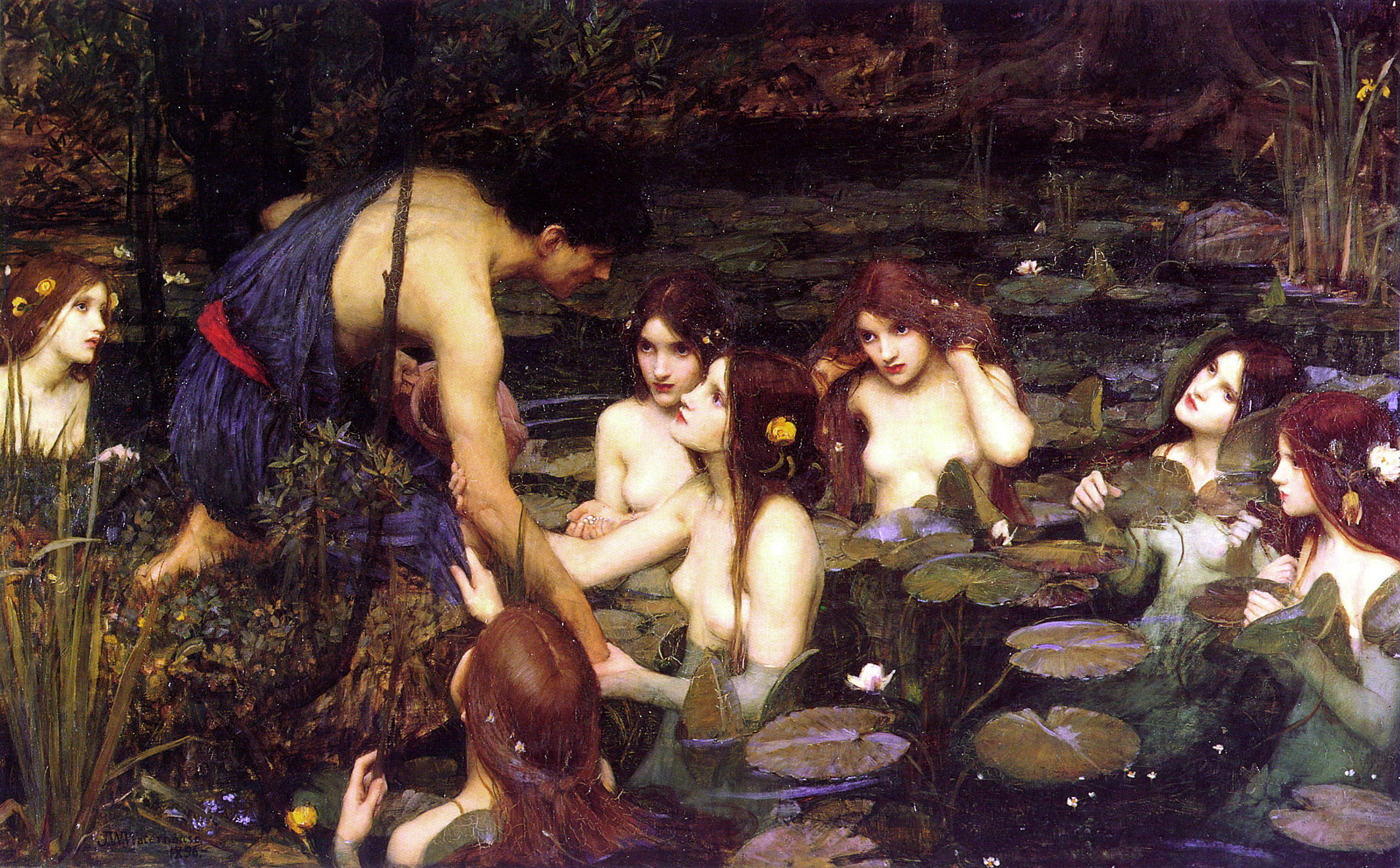
In Greek mythology, there are others that have the qualities of seductive, deadly women. Sirens (along with mermaids and nymphs) were feared for luring men into drowning by playing their lovely music, singing, or by their appearance alone. Clytemnestra, was Helen's half sister. She is infamously remembered for killing her husband, Agamemnon, after he returns from Troy, so that she can marry Aegisthus. Circe, the enchantress, briefly held Odysseus's men captive after transforming them into pigs with drug laced wine. The Sphinx, borrowed from Egyptian lore, was a female hybrid creature said to devour any man who could not solve her riddles. Hecate, was known as the goddess of crossroads, misfortune, and accidents. She would later become associated with the mysteriousness of the night and witchcraft.
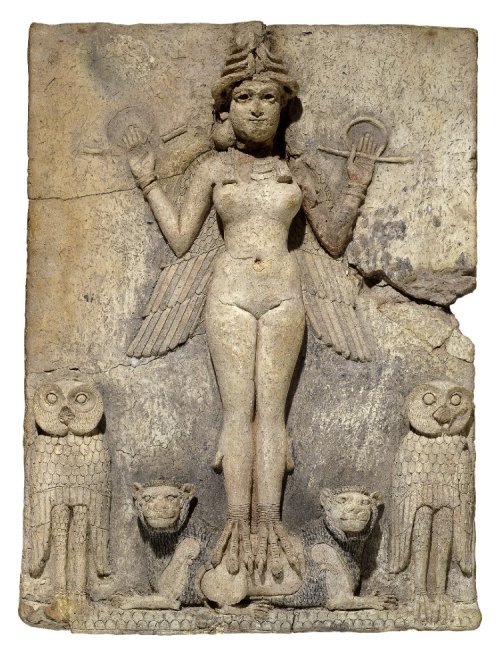
Biblical texts also mentions several femme fatale like women in its Hebrew portion. Vanity and giving into temptation or seduction are commonly considered to be crimes in many religions. Although Eve is not really a femme fatale, she certainly represented the fear of disobeying God when she committed the first sin on Earth (similar to how Pandora could not contain her curiosity and opened the box she was given, letting misfortune into the world). Lilith ('screech owl'), was a female figure based off of earlier Mesopotamian demons, and Delilah was known for betraying Sampson when she cut his hair. Also notable were Salome, who gets revenge for her mother by receiving John the Baptist's head in return for her dancing, and Jezebel, who was a Phoenician queen and 'enemy of God's prophets'.
In Medieval to early Renaissance times, women acting out of line or seductively would become associated with witchcraft. This basis had its roots in the earlier mentioned religion and folklore, and also from the Roman goddess Diana. Diana was representative of the moon, hunting, woods, and childrearing. Fertility cults that worshipped Diana at night would later be charged of performing witchcraft and practicing the witches's sabbath, likely as an attempt to wipe out Paganism. (Christianity is a very cumulative religion, and any beliefs not absorbed by it were often shunned or considered to be the work of the Devil / evil during this time period.) The idea of rebellion or 'shameless sexual activity', was particularly disconcerting to many people in the early Renaissance. This along with several crises at the time (religious upheaval, a changing European economy, and widespread epidemic diseases) caused society to look for an ideal scapegoat, which unfortunately often happened to be older, defenseless women who were widowed or social outcasts. The magic attributed to such witches could have had its basis in sexual desires, vanity, assertive behavior, or deception, all of which are traits commonly associated with the femme fatale archetype.
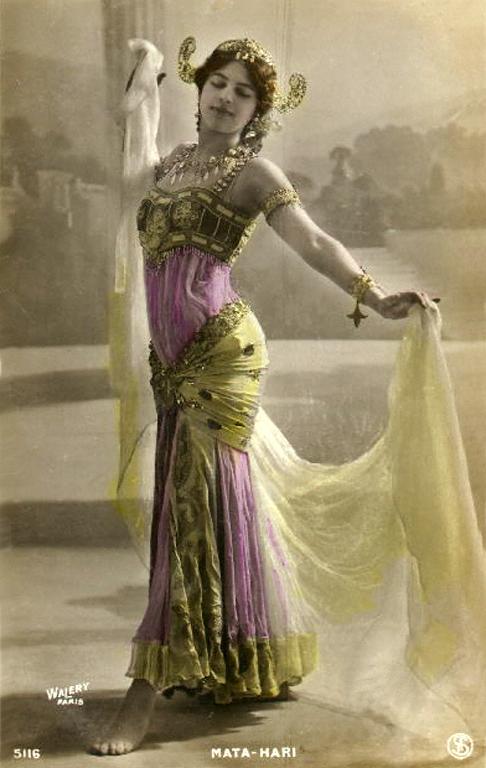
Outside of fiction and witch trails, there were several real life people who are considered to be femme fatales. Cleopatra, although much of her life in popular culture is fictionalized, is probably the most famous example. Coming from a family of Greek origin, Cleopatra ruled Egypt from approximately 69 to 30 BC. She was the last pharaoh and had affairs with powerful Roman generals Julius Cesar and Mark Antony. Mata Hari was a supposed German spy who acted as an erotic dancer and entertainer. She was executed by the French army in 1917. More recently, Anna Chapman was also accused of being a spy. She was posing as a fashion model in order to obtain information about the US for the Russian government.
Mata Hari, the world's most famous female spy.
In film, arguably the first major femme fatal figure was Theda Bara, famous for her portrayal as the 'vamp', one of cinema's earliest sex symbols. She wore many outfits that were (and still are) rather racy, perhaps in part prompting Hollywood to adopt the Hayes Box Office Code about ten years later. She is best known for starring in A Fool There Was (1915), Cleopatra (1917), and The She Devil (1918). Most of Bara's films are now lost due to many being destroyed with the implantation of The Hayes Code or burning in fires.
Louis "Lulu" Brooks was another notable silent film star. She was a fiercely outspoken and independent woman who initially started her career in Hollywood, but would later move to Germany after a falling out over the use of sound with Paramount (for The Canary Murder Case [1929]). She was a critic of the Hollywood system, popularized the bobbed hair cut, and would go to star in more complex, darker films after leaving America. Brooks had several affairs (once even with Charlie Chaplin), but was never able to achieve a stable marriage, which she attributes to being assaulted at age nine, making her leery of entering long time relationships. Her greatest films arguably were Beggars for Life (1928), Pandora's Box (1929), Diary of a Lost Girl (1929), and Prix de Beaute (1930).
Many of these silent femme fatales, such as Louis Glaum and Musidora, were foreign in appearance (specifically Eastern European or Asian) which added to their mysterious allure. Their assertive and sometimes wild behavior was also a reflection of the increasing presence of women in the 1920s outside of the domestic sphere (the flapper, women gaining the right to vote with the 19th Amendment, more women going to college, etc). These actresses were the exact opposite of the more wholesome and innocent performances of stars such as Lillian Gish or Mary Pickford.
The few remaining seconds discovered of Theda Bara as Cleopatra (1917), and an interview with Bara.
Louise Brooks was another silent film femme fatale.
In the 1940s, many German filmmakers fled their homeland to avoid censorship from the Nazi regime and brought their unique, dark, and complex expressionist style with them, forever altering America cinema. Film Noir thus came into being and its style was adopted by several famous directors, including Alferd Hitchcock and Orson Wells. It is characterized by its crime ridden plot lines commonly involving antiheroes, dramatic black and white lighting, and (surprise!) femme fatales. The goal of film noir was to challenge the Hays Code and typical, 'safer' American movies made at the time. Some of the most famous film noir films include: Rebecca (1940), Citizen Cane (1941), The Maltese Falcon (1941), Laura (1944), The Big Sleep (1946), Gilda (1946), Out of the Past (1947), Vertigo (1958), and Psycho (1960). Sunset Blvd (1950) was particularly interesting. It cast Gloria Swanson as Norma Desmond, an eccentric former silent film star, obsessed with rising back to fame and her ill fated relationship with the young screenwriter Joe Gillis (William Holden).
"All right Mr. DeMillie, I'm ready for my closeup."
To this day, there are many films that follow the pattern of femme fatales found in film noir. Some recent examples of 'neo-noir' fatales include the likes of Evelyn Mulwray from Chinatown (1974), Matty Walker of Body Heat (1981), Alex Forrest from Fatal Attraction (1987), Lynn Bracken from L.A. Confidential (1997), and Mal Cobb from Inception (2010). A notable example of the femme fatale is the 'Bond Girl.' A Bond Girl is any of the classy, outspoken women from the James Bond film series. They are known for their often sexually suggestive names, troubled pasts, and penchant for betrayal. Femme fatales are common outside of American cinema as well, perhaps the best know being the anime characters Fujiko Mime from the Lupin the Thirdfranchise and Fey from Cowboy Bebop (1998).
Parodies of the femme fatale have also been popular ever since the 1940s. Animator Tex Avery gave as Red Hot Riding (1943) which mocked traditional fairytale conventions by updating them for modern audiences. Eartha Kitt's enjoyably campy performance for the third season original Batman show (1967 - 1968), was laced with puns and hamminess. Jessica Rabbit from Who Framed Roger Rabbit? (1988) makes a tongue in cheek reference to the archetype stating, "I'm not bad. I'm just drawn that way." Kiss Kiss Bang Bang (2005) poked fun at noir conventions with its twisted black humor and plot about a thief being mistaken for an actor and detective.
Parodying the femme fatale: Eirtha Kitt as Catwoman!
Fujiko Mime, anime's answer to the fatale archetype.
Whether you agree with the implications of the character role or not, the femme fatale is here to stay and has long been part of our cultural heritage and imagination. She can be seen as a threat to traditional gender roles, a sexually liberated individual, or a manipulative honey trap. Depending on the context, this woman archetype is commonly seen as a cool, confident woman or nuisance to beware of. In either case, the femme fatale is one of the most recognizable figures conceived for fiction.
Some select trailers for Metropolis just to show off how amazing it was for its time (and still is). The first three were made to promote the newly restored Kino version released in 2010. If you decide to watch Metropolis, watch this version!* It contains many newly discovered scenes and features a documentary about the history of its restoration. It also features the film's original soundtrack. The 4th trailer is from a controversial restoration made in the 1980s... using color dyes and pop music?! What were they thinking? Also the announcer said the film was made in 1926, wrong!
*The Kino Version is now on Hulu! Click here to watch it!
Year: 1927 (the most recently restored version from Kino International was released in 2010)
Country: Germany
One of the most influential films of all time with a message that is still relevant today.
Metropolis is one of the most recognizable movies in movie history. It was a product of the German Expressionist Era and one of the most elaborately detailed and expensive films of its time. Even if someone has not seen the film, it is likely that they will recognize its imagery and virtually impossible for them to not to have seen another movie influenced by it (i.e. Star Wars or any other Sci-Fi film ever made). Metropolis is set in a futuristic dystopian society. The ruling elite live above ground in a vast city akin to paradise at the expense of the working underclass who live below them. Freder, son of the city's leader Joh Federsen, falls head over heels for woman named Maria. He attempts to follow Maria, but ends up getting lost in the worker complexes below. Freder is horrified by what he sees and later finds Maria. He agrees to help her work towards peace between the two classes by acting as mediator between them. However, Joh and the scientist, Rotwang, discover the plan. Rotwang kidnaps Maria and makes a robotic doppelgänger in her guise in order to manipulate the masses, and turns it against Joh.
How do you solve a problem like Maria? Apparently, Rotwang knows.
Metropolis, is at heart, an allegory about how society must learn to function in order to survive. It is a warning about the dangers of classism, worker exploitation, mob mentality, and corruption. Yet the film also offers hope for a better future, stating that,"the mediator between the hands and the head must be the heart." Thus, in order for people to live together peacefully, they must be willing to put aside their differences and come to a compromise.
Metropolis also uses lots of religious imagery to get across its message. In one scene, Freder sees a machine that some of the workers are operating explode, killing several people. Freder panics then hallucinates that the machine transforms into the terrible demon, Moloch. Moloch was a pagan deity that was provided human sacrifices. In another part of the film, Maria is preaching to the workers about her vision of peace. She mentions the Tower of Babel, which fell due to people working on it becoming to prideful and failing to understand each other. The tall building which Joh rules from is referenced as 'The New Tower of Babel' throughout the film, making the parallels clear. At one point, Freder trades places with one of the workers in order to experience what has been going on unseen his entire life. He works a grueling ten hour shift, managing the hands of a clock. As Freder strains to keep the hands in place, it resembles a crucification. This shows how the workers must sacrifice time each day, to the seemingly unappreciative elite.
Freder's terrifying vision of the M Machine transforming into Moloch.
"Father! Father! Will ten hours never end?"
Each character in Metropolis have widely varying motives and well developed personalties. Joh Federsen seems like a heartless man who rules with an iron fist, at first. However, we later learn that Joh cares deeply for his son. He is so stern partly because his wife died in childbirth and he fears losing Freder. Rotwang set the archetype of the 'mad scientist' character and represents the consequences of playing God. Freder acts as the audience's guide into the world of Metropolis. He starts of very naive, and somewhat spoiled, but quickly learns about the inequality around him after he meets Maria. He then acts as the 'link' to build understanding between the social classes.
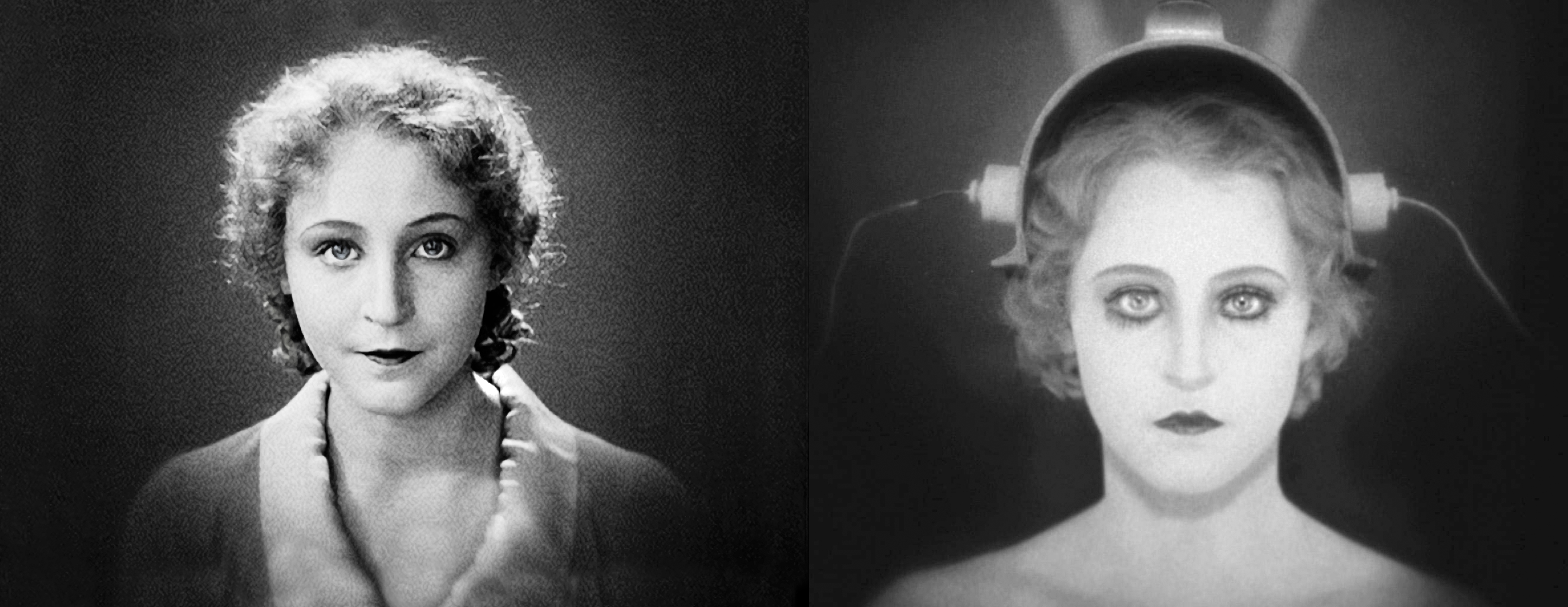
It is very interesting to compare Maria to her robotic counterpart. Maria is is kind towards all people, despite their social status, and cares a lot for the needy and their childern. The 'False' Maria exactly the opposite. She has been programed to deceive all men and urges the working class to act out violently, to rise up in rebellion against the upperclass (not caring that the worker's city is being flooded at the exact same moment!) The robot's behavior is reflected by actress Bridgett Helm's heavy makeup and jerky / eccentric movements. When Helm portrays Maria, she dresses more nicely and is far more composed. The scene where False Maria is depicted as the Whore of Babylon, represents the sins and lust of man. It also suggests that if the actions of Rotwang's invention were to go out of hand, there could be apocalyptic consequences.
Maria vs False Maria
False Maria as The Whore of Babylon.
The cinematography of this movie is stunning, especially when you consider when it was made. The expertly made miniatures and large-scale sets prove that a film does not need to rely heavily on CGI in order to be breathtakingly beautiful. Each scene conveys a mood, in typical Expressionist style. It is very easy to be impressed by the glorious city of Metropolis, but also to pity the underclass who toil below in dismal conditions. The original score of the film, by Gottfired Huppertz, truly adds to the atmosphere of Metropolis and is, perhaps, one of the most haunting scores ever created for a motion picture. (And a good score is absolutely essential to keep an audience's attention for a silent film!)
The world of the elite.
The 'underworld' of the workers.
This movie is a definite must-see for anyone who is interested in film. Metropolis is a work of art. Not only is it beautiful to look at, but it also has a heart. Don't ignore it just because it is a silent film. If any film from our era is as good as Metropolis in 85 years, then we will be fortunate indeed.
Sunrise (1927), an example of an American film by a German director.
There is no doubt that the one of the greatest art forms to come out of the 20th century is movie making. Virtually, anybody alive today has a favorite movie or at least seen numerous films throughout their lifetime. But very few know about how, in the early, silent years of cinema, Hollywood was changed forever by the influence of German filmmakers.
Throughout the mid 1910s to 1920s, the American film industry focused mainly on only two main genres, action/adventure films (which were mainly based off historical events or novels) and comedies. Popular Hollywood films at the time were: D.W. Griffith’s controversial, but highly influential Birth of A Nation (1915); the foreign fantasy, The Sheik (1921); The Mark of Zorro (1920) and The Thief of Baghdad (1924). But comedians (like Charlie Chaplin, Buster Keaton, Harold Lloyd) and comedic cartoons (such as Felix the Cat and Oswald the Lucky Rabbit) arguably met the widest success.
Charlie Chaplin, one of the most famous American silent Stars.
Felix the Cat was to cartoons what Chaplin was to American cinema.
However, filmmaking in Europe focused less on action-adventure and comedic routines than Hollywood did, and more on experimentation, visuals, emotion, and the flaws of human nature. This is particularly true in the case of German Expressionism- a term used to describe the unique take of German filmmakers during the era. The movement was characterized by its usage of elaborate sets and exaggerated acting to emphasize mood, abstract scenery, high contrast lighting, and had a tendency to tackle darker subject matter. The plots and stories of the Expressionist films often dealt with madness, insanity, betrayal, and other “intellectual” topics. Some of the most famous expressionist films are: The Cabinet of Dr. Caligari (1920), The Golem (1920), Nosferatu (1922), Faust (1924) Metropolis (1927), Pandora’s Box (1929), and M (1931).
A typical German Expressionist Film: moody, experimental, elaborately made, and dark.
The Cabinet of Dr. Caligari is a bizarre frame story in which a man retells his experience with a creepy carnival overruled by the hypnotist, Caligari, and the sleepwalker Caligari controls in order to carry out murders. It was one of the first movies to feature a twist ending (the narrator is revealed to be mentally insane). This film was hugely influential on many directors, like all expressionist films, but most notably Tim Burton. This can be seen in Burton’s fondness of using outlandish and geometrical sets, the resemblance of Edward Scissorhands to Cesare (the sleepwalker), and the dreamlike atmosphere in his films.
It's easy to see the influence of this film on Tim Burton's style.
The Golem, Nosferatu, and Faust are arguably the expressionist films most responsible for creating the horror genre. All of three dealt with the supernatural, malicious beings or monsters, and featured dark and/or tragic storylines. The Golem was about rabbi creating a clay warrior to protect the Jews from being prosecuted, but his creation goes out of control. (This is pretty eerie considering that the Holocaust occurred twenty years later.) Nosferatu was one of the earliest vampire films, heavily borrowed from Dracula, and linked the legend to the spread of the black plague. Faust, which was also adapted from a classic novel, was about an alchemist conflicted by his own selfish ambitions motivated by the Devil and his desire to do good. The effects of these films were felt immediately as Hollywood began releasing films like The Phantom of the Opera, The Hunchback of Notre Dame, and Frankenstein over the next several years.
Nosferatu is a vampire.
This thing is not.
Metropolis is the story of a dystopian future were the elite live in luxury at the expense of the underclass workers who live below surface. When a woman named Maria tries to bring peace between the exploited workers and the elite, a robot duplicate is given her image so it can manipulate the masses and crush any chance of rebellion. It was the most expensive silent film costing over 7 million Reichmarks which would be about $200 million today. Metropolis’s influence was huge. It is widely considered to be the first major (and most significant) science fiction film and featured ground-breaking special affects. Even today it has continued to be used as inspiration where you would least expect. For example, strangely enough, Lady Gaga. The name Lady Gaga actually comes from a music video by Queen entitled “Radio Gaga” which uses footage from Metropolis. Lady Gaga’s outlandish costumes also seem to be sometimes inspired by the Maria robot or the film’s bizarre dance scene.
Marvel at how the miniatures were made.
Words can not describe how groundbreaking Metropolis was.
Among the last German expressionist films made were Pandora’s Box and M. Both were less abstract in nature, set in contemporary times with a crime backdrop, and focused more on flawed, tormented characters with questionable motives. Pandora’s Box was about a woman whose selfish, seductive behavior ignites jealously in men causing her to be accused of manslaughter when one of her lovers murders another man. M featured a detective trying to track down a troubled child murderer.
Pandoras' Box and M are perhaps the most Film Noir-like of German films.
By the end of the 1920s, the German film industry became increasingly regulated as the Nazi Regime rose to power. Many artists and filmmakers fled to Hollywood so they could continue to keep making films (and many of them also happened to be Jewish). They brought with them their unique visions and created a new major movement in Hollywood, Film Noir. Film Noir was also made in response to The Hays Box Office Code, which regulated the film industry causing many 'safe' films to made throughout the 1940s and 50s (i.e. musical romantic comedies). Film Noir movies were crime dramas shot in black and white, featured characters with questionable motives, femme fatales, and dramatic lighting. (Sound familiar?) This in turn eventually changed the whole Hollywood film industry by causing The Hayes Box Office Code to loosen its restrictions and eventually be replaced by the film rating system. Because German Expressionism influenced Film Noir it also influenced countless directors (ranging from Orson Welles, to Alfred Hitchcock, to Ridley Scott) which made way for the variety of films we experience in modern cinema today.
Typical Film Noir movies. Notice how similar they looks to German Expressionist Films!
Alferd Hitchcock studied film in Germany for a while.
Thus, German Expressionist Films are hugely important to many aspects of film today. The genres Horror and Film Noir owe their origin to it. Expressionism, through influencing Film Noir, eventually resulted in the fall of the Hays Box Office Code. Countless directors also owe some of their success to techniques they picked up from German filmmakers. So next time you watch a movie, check to see if you can spot any traits associated with German Expressionism. You might be surprised.
Citizen Cane, Sunset Blvd, The Godfather, Blade Runner, and even The Dark Knight are just a few examples of films influenced by the long legacy of German Expressionism.