Making an animated film is a long and complicated process. Many films spend years, sometimes even decades in development. ( In an extreme case, Ricard William's The Thief and the Cobbler spent about 30 years in limbo before it was released in 1993.) Here are some films by renowned animator, Don Bluth, that sadly never got to see the light of day. Bluth often struggled with finical troubles, particularly after his studio tanked in the mid 1990s. Here's a small glimpse at what could have been.
The Little Blue Whale:
Satyrday: The Velveteen Rabbit:
East of the Sun, West of the Moon:
was meant to be released after the Secret of NIMH (1982), but but the union went on strike for 73 days.
Here are some trailers for The Illusionist. The Warner Brothers trailer really does a nice job of covering the visual aspects of the film and its gentle humor. It is still somewhat hard to believe that this film lost to Toy Story 3 at the Academy Awards. (Yes, I love Pixar, but they don't have to win everything.) This film is criminally overlooked.
Director: Sylvain Chomet Company: Pathé / Django Films Year: 2010 Country: France
Can old traditions survive the modern world?
The Illusionist centers around an aging magician who constantly travels in order to find new work. He struggles to find employment in the ever changing world around him. In 1950s Europe there is no longer room for professions like the old man’s. TV, rock bands, and mass media have rendered old fashioned entertainers useless. This intrusion of new technology on old European traditions makes the viewer question our own lives and dependence on large scale entertainment at the expense of the common man. Other venders (such as an alcoholic ventriloquist and a clown with suicidal tendencies) aren’t as lucky as the illusionist. They fall into obscurity foreshadowing the illusionist’s own fate.
'The Britoons' not to be confused with another more famous band.
Yet the film is not completely bleak or pessimistic. It contains several moments of humor and lightheartedness. The magician’s finger-biting rabbit surely seems to be a descendent of the white rabbit from Monty Python and the Holy Grail. Other cast members such as a pompous Elvis impersonator, crazy acrobats, and drunken Scotsman also add to the amusement. The magician frequently stumbles around in his old age, unable to keep pace with the modern world. He often finds himself in hilarious and ridiculous situations such as selling ladies’ undergarments in a department store or vainly trying to remove an oil splotch on a car.
Luckily, the illusionist finds comfort in an unusual friendship with a poor orphaned girl, Alice. She manages to befriend the man and the illusionist soon adopts her into his life and they travel together. The relationship between them is an interesting one. Alice sees the magician as a way out of her isolated lifestyle and he becomes somewhat of a father figure towards her. The magician even begins to work late night shifts to pay for all of the clothing and gifts he buys for her. He also seems to develop love towards Alice and is sad when he realizes that she will grow up and leave.
Beware the rabbit.
The Illusionist stands out among other movies in its genre for three obvious reasons: its aimed at more adult audiences, contains virtually no dialogue, and it is traditionally animated. Hand drawn animation is novelty nowadays where CGI rules supreme. Few studios dare to rely on the medium except those overseas. The details in the film are amazing. Paris and England are drawn in a style resembling Impressionalist paintings. Accurately drawn subways, bus cars, city lights, and cracks in city pavement appear in each scene. The animated characters themselves are simply rendered and resemble a cross between Herge’s Tintin comics and the works of Studio Ghibli.
Hand drawn backgrounds at their finest.
The Illusionist is a wonderful and one of a kind film. I would not recommend it to the ‘typical’ Hollywood crowd expecting action thrillers or animated films about cartoon animals and fart jokes. (Yes, I’m looking at you Dreamworks.) However, I do highly recommend the film to those interested in watching something a bit more different and bold in its approach. Whoever believes that cartoons are just for kids is sadly misinformed.
Director: Peter Jackson
Company: New Line Cinema / WingNut Films
Year: 2012
Country: USA / New Zealand
Does this highly anticipated film deliver?
Every so once in a while, there is a movie that comes along which leaves you with conflicting feelings. Unfortunately, The Hobbit: An Unexpected Journey is such a film. It suffers from being overstuffed with plot elements that were not originally from the book. Quite a few scenes are lifted from The Silmarillion (the inclusion of the Galaderial and Saruman at the White Counsel) or even created on the spot (like Radagast the Brown's rabbit sled). The Hobbit is a far simpler and shorter story than the Lord of the Rings, so really it should have been shot in two, or maybe even one movie. It is almost painful to admit that the animated TV special from 1977 actually follows the book more closely, despite its exclusion of the Arkenstone and the bear-man Beorn (not to mention its grotesque character designs).
Radagast's scenes are borderline ridiculous, involving blowdrying a hedgehog and driving a rabbit sled.
Yes, this version is actually more loyal to the book...
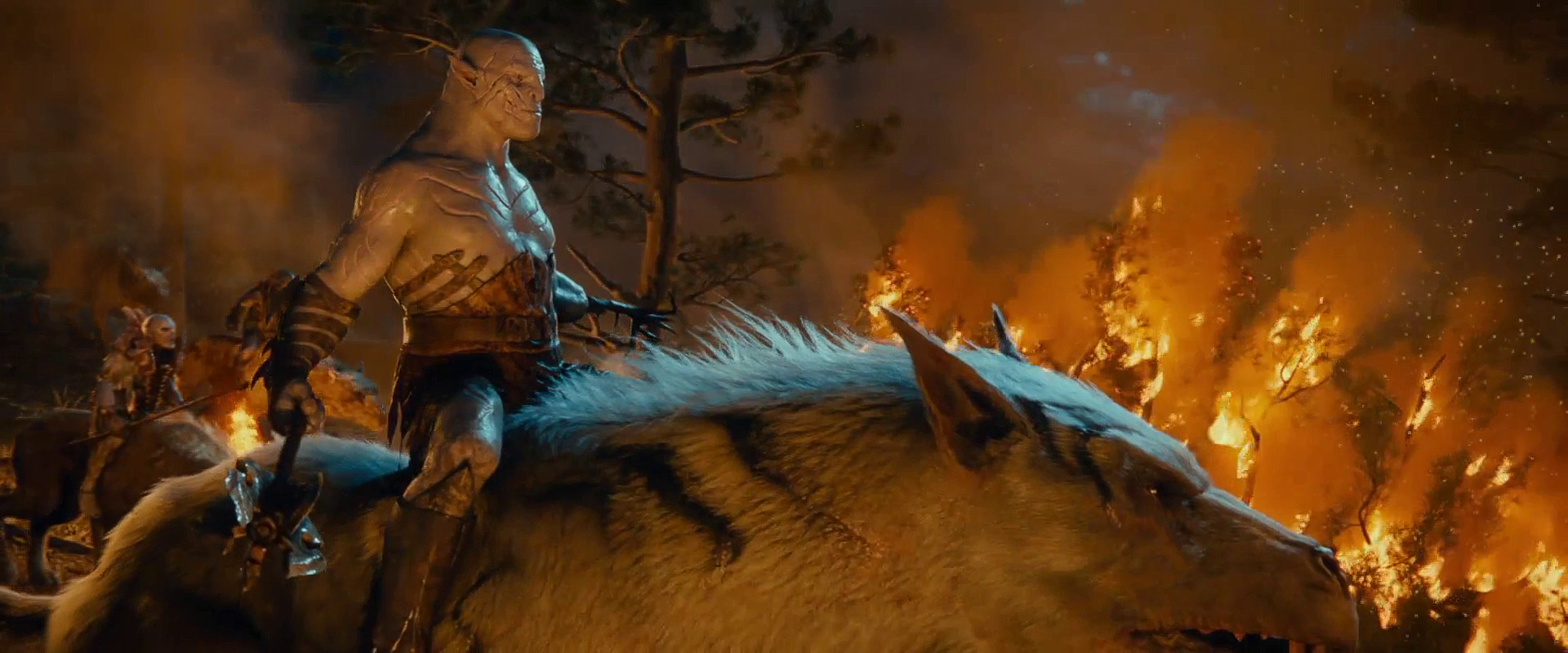
But by far the most glaring problem with this adaptation is the subplot involving Thorin and the white orc, Azog. Thorin already has enough of a reason to be a relatable character. He feels responsible for the loss of his home under the Lonely Mountain (which was taken by Smaug) and loathes the elves for not helping his people. Azog just seemed like an excuse to squeeze in more long, dragged out fight scenes and show off special effects. He has no character development and looks like a video game boss. (He has a giant hook for an arm. Seriously?) The excessive computer animation on the orcs and fight scenes actually makes the movie seem less real and more fake. Just compare it to the actors wearing orc makeup in the LOTR trilogy.
Intimidating and believable orcs from the Lord of the Rings.
Unnecessary and fake-looking orcs from The Hobbit.
However, the film is not a complete disaster, far from it in fact. Andy Serkins as Golem and Ian Mckellen as Gandalf are great as always. The film does an excellent job of setting the scene in the Shire and remains easy to follow and relatively enjoyable for the first half. (Up until the point Radagast the Brown and the orcs are introduced.) The Goblin King is goofy, but definitely more enjoyable than the Azog. And of course the cinematography, landscape of New Zealand, and score are all quite breathtaking.
Now I want to have a tour of Hobbiton.
Howard Shore is one of the best film composers of our time.
So overall, I would not recommend seeing The Hobbit in theaters. Diehard fans are sure to be disappointed and the second half of the film tends to drag on with cartoony action scenes. However, this film really is strong in places were it follows the book closely and is truly beautiful at times. For those curious, rent The Hobbit when it comes out on DVD, watch the good scenes and fast-forward through the bad ones.
A sketch of Walt Disney drawn right before the studio strike or after the completion of Snow White by an unknown animator.
Another one of Walt by one of his animators. Done in 1930.
The matador from Ferdinand the Bull (1938) was animated by Ward Kimball based off of Walt.
Ward Kimball himself also appears as a cartoon in Ferdinand.
A Valentine's drawing by Ward for his wife, Betty.
Ollie Johnston, another one of Disney's 'Nine Old Men', makes a cameo in Brad Bird's The Iron Giant (1999) and the Incredibles (2004, alongside Frank Thomas).
Ollie modeled Rufus the Cat from the Rescuers (1977) after himself.
Glen Keane's drawing of Ollie and his wife as Tarzan and Jane.
An excellent Google Doodle made of Mary Blair.
Christmas card by Andreas Deja featuring himself.
Apparently, Hades from Hercules (1997) was based off of Jeffery Katzenberg. Katzenberg was the most hated man at Disney during that time. After a fight with Michael Eisner, he later left the studio and helped establish Dreamworks.
Speaking of which, Dreamwork's first hit animated film, Shrek (2001), gave us the villain Lord Farquaad...who was based off Michael Eisner.